Table of Contents
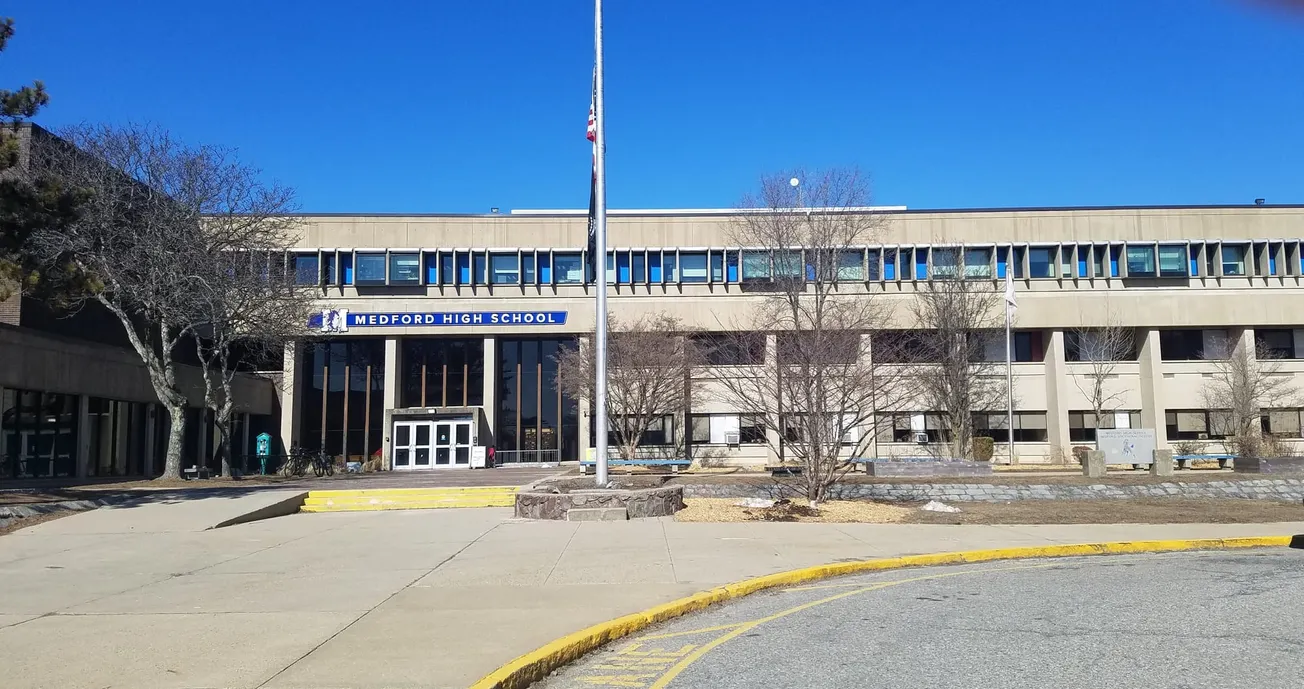
To cut or not to cut? That was the question Medford Comprehensive High School Building Committee (MCHSBC) members struggled with on April 27 during a public meeting where the permanent removal of square footage was on the table.
More than 200 proposals for space changes were made by committee members and split into the following three categories:
• Category A: Space changes made by the Educational Leadership Team that would not impede the educational plan approved and voted on by the School Committee.
• Category B: Space changes made by other members of the committee that would not impede the educational plan.
• Category C: Space changes made by other members of the committee that would impede the educational plan.
The committee also voted on how proposals would be discussed in order to keep the meeting from running into several hours.
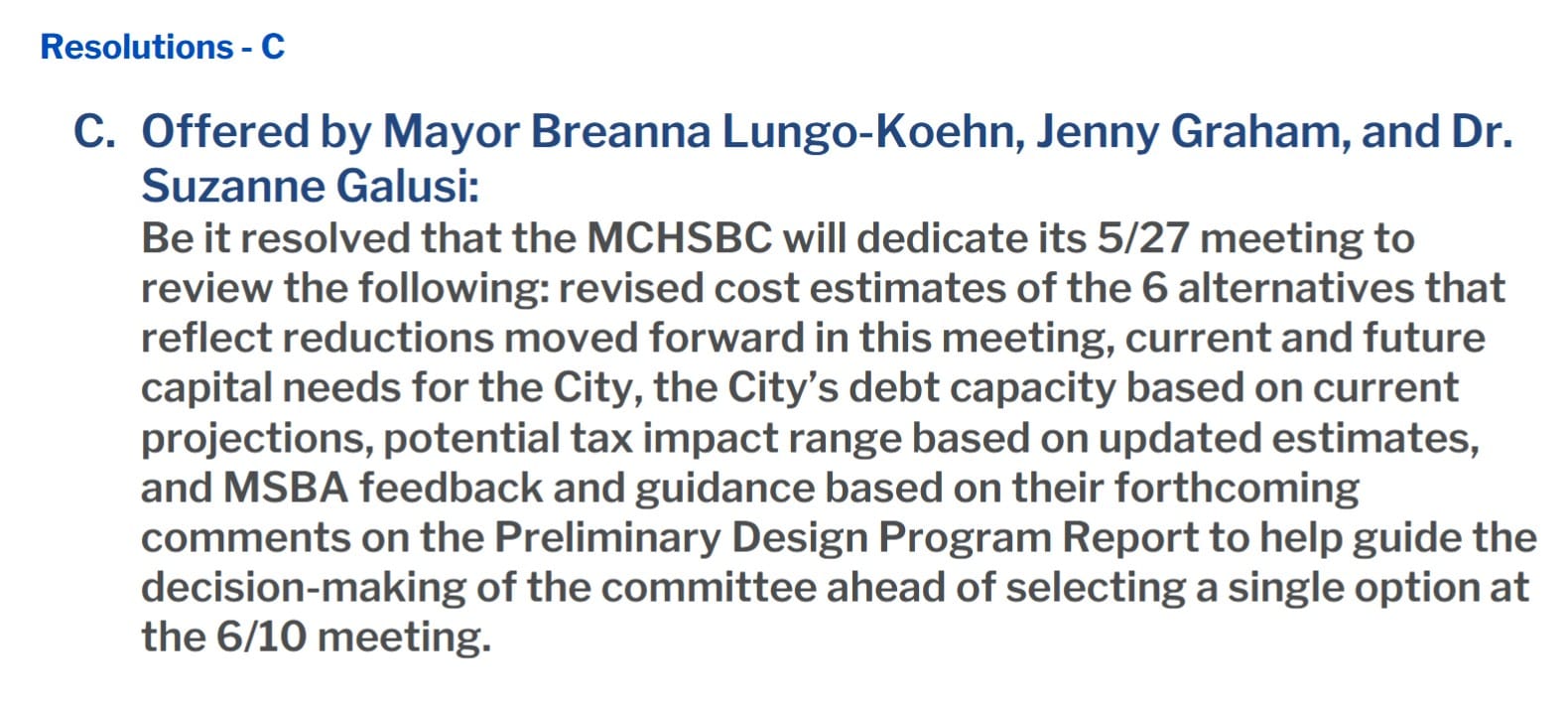
Additionally, a resolution was put forth by Mayor Breanna Lungo-Koehn, MCHSBC Chair Jenny Graham, and Superintendent Dr. Suzanne Galusi to dedicate the May 27 meeting to review revised cost estimates of the six design alternatives to reflect the reductions being made on April 27.
The resolution also asked for a presentation that would discuss Medford’s current and future capital needs.
The mayor said she had hoped to discuss the city’s finances at this meeting but could wait until May 27, adding it was “extremely important to have this conversation.”
Lungo-Koehn said the last thing she wanted to see was the debt exclusion for the project fail. The mayor started to provide some preliminary numbers but was cut off by Graham, who said the discussion shouldn’t be a topic of conversation during the meeting.
“It has to be addressed a little bit because we’re a committee that wants to see the biggest and the best for our kids and our faculty. I’m one of those people,” Lungo-Koehn said. “It needs to be mentioned because I also put in space reductions, not because I don’t want the biggest and the best high school, but I want to reduce the space and, in the end, reduce the cost for all our residents who live and rent here.”
The mayor added the estimated amount of upwards of $800 million for the project “is, quite honestly, scary to me.”
Lungo-Koehn said it was difficult to consider a debt exclusion not passing next spring after so much work being done. Or worse, she added, if the override just squeaks by, leaving a lot of residents to “struggle.”
“I’m saying it bluntly,” she said. “We really don’t have the debt capacity to put much of this on the city’s debt.”
The mayor listed a multitude of capital needs, from a new fire station to repairing streets and sidewalks to the flooded recreation center.
“And the list goes on and on,” she said, reiterating she would wait for May 27 to present a fuller financial picture for the committee but that there had to be “some level of transparency and how much this will cost the average taxpayer or renter.”
“I’m not trying to scare anybody, but I want to help this committee reduce space, now and in the future, knowing we all want the same thing: a new high school that meets the needs of our students, but not at 640,000 square foot and not as the most expensive in the nation,” she said.
But City Councilor Emily Lazzaro took exception to the mayor’s comments.
“It’s not reasonable or respectful of our residents to be fear-mongering or throwing out numbers that are inventive,” she said. “I just think it’s really important that what we talk about today is based on real estimates with real numbers and not things that we have created based on nothing."
“We are trying to make these decisions now and then receive estimates for the future,” Lazzaro continued. “We cannot govern the city and build new things in a culture of fear and resistance to change and improvement and progress.”
Lungo-Koehn, however, said residents have figured out what the city might be facing in terms of paying for such a big school based on $900 million.
“It’s facts,” she said. “We have a vote to take in 13 months, but we need to put the facts on the table for residents. The committee needs to reduce space and, in the end, the cost while still creating a wonderful project for the community at large and our kids.”
The city, however, has yet to receive any feedback from the Massachusetts School Building Authority from the Preliminary Design Program submission. Without that information, said LeftField Senior Project Manager Jen Carlson, there’s no way to calculate a potential rate of reimbursement.
“We need to get the MSBA numbers and get the ranges for reimbursement,” she said. “It could change by the time of the schematic design phase. It’s very important to note that number can change by the design phase.”
Carlson added by the time the schematic design is ready, Medford will have all the numbers and estimates for the final project.
“When we submit the schematic design report to the MSBA, that’s the budget for the project,” she explained. “That’s why it’s important to get the information.”
She said this is all very “normal” for the MSBA timeline.
When asked how much time the building committee could have in terms of reducing space, Carlson said the “pencil down” deadline is likely October.
Public reaction
During the 3 ½-hour meeting on Monday, residents who attended both in person and online spoke during the public portion of the meeting about the fact that while they were supportive of the project, many weren’t on board with making cuts that are permanent before there are any firm numbers. Others just weren’t sure about the extreme cost and said making cuts now brings down that final price tag later.
“You don’t need to make cuts without a final design,” said School Committee member Mike Mastrobuoni, who was on hand for the meeting. “I urge caution in making changes, even though the pressure is on with the costs.”
City Council President Zac Bears, who was in the audience, complimented the work done by the committee but also cautioned the body about removing space that might be needed later.
“A lot of the narrative will be the cost before accurate cost estimates and a real understanding of what this project means is falling into Medford’s classic trap,” Bears said, “which is a presumption of failure, a presumption that we will not be able to negotiate effectively with the MSBA, a presumption that we will not be able to find other ways to afford the project, a presumption that we will not be able to do the creative work between now and October to make cuts that minimize the impact on programs, maximize value to the students, and I think it just sets the project up for a harder run at a debt exclusion.”
Resident Eileen Lerner agreed there’s a lot of fear not only in Medford but across the country and the world. She said it’s important to act on this project, “not out of fear, but act out of optimism.”
Several residents said they supported the project and were aware they would be paying for a new high school, possibly for the rest of their lives. But, Susan Wilson said, the city gets one chance to do this project right.
“We have to plan for the future,” Wilson said. “There’s a real cost to the cuts you make, but you don’t need to do it now. There are moments to do it later when you have the real numbers.”
The cuts
Despite the urging of residents, the building committee split the decision on what cuts it would tackle.
The committee moved ahead with Category A cuts, which were based on many meetings among school leadership and the space summary done by SMMA, the project architects.
Galusi said the education plan was the “north star” in terms of how the leadership made its proposals for cuts. She said those decisions were based on the three Rs: repurpose, redundancies and reductions.
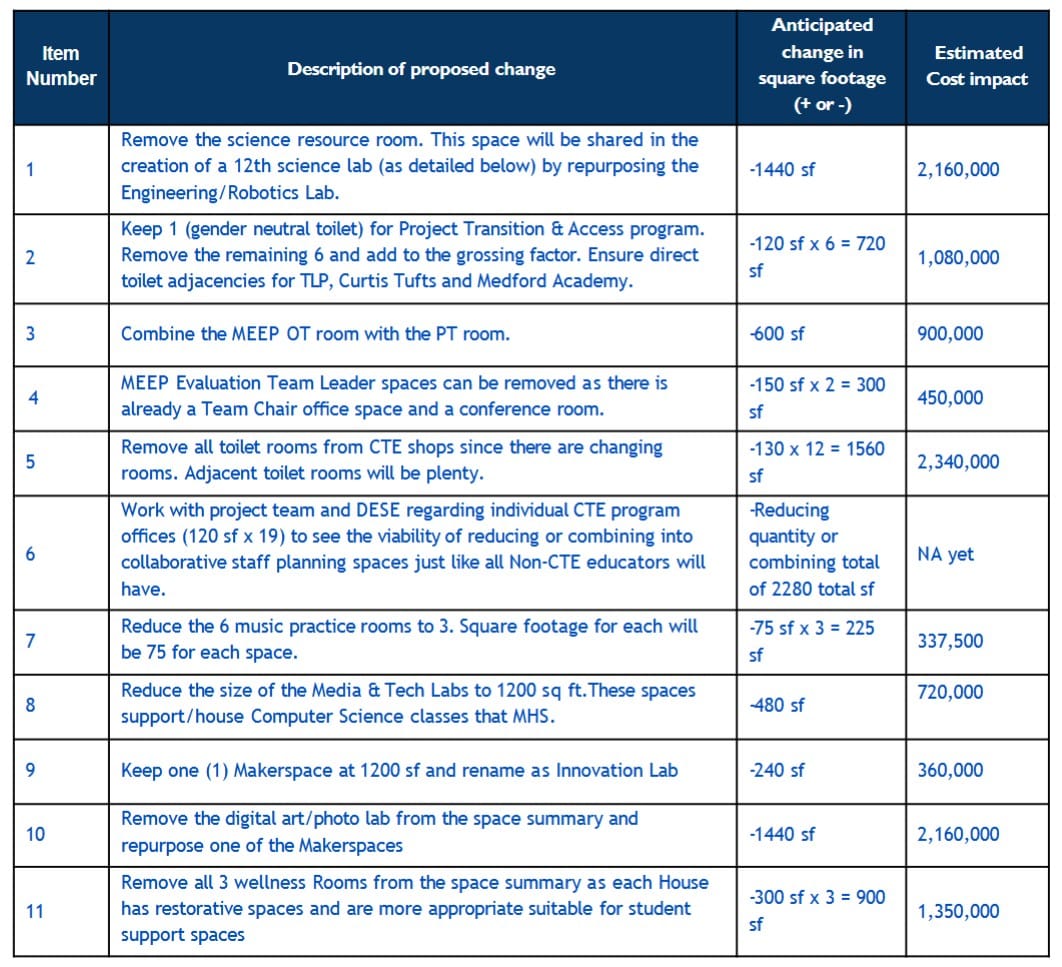
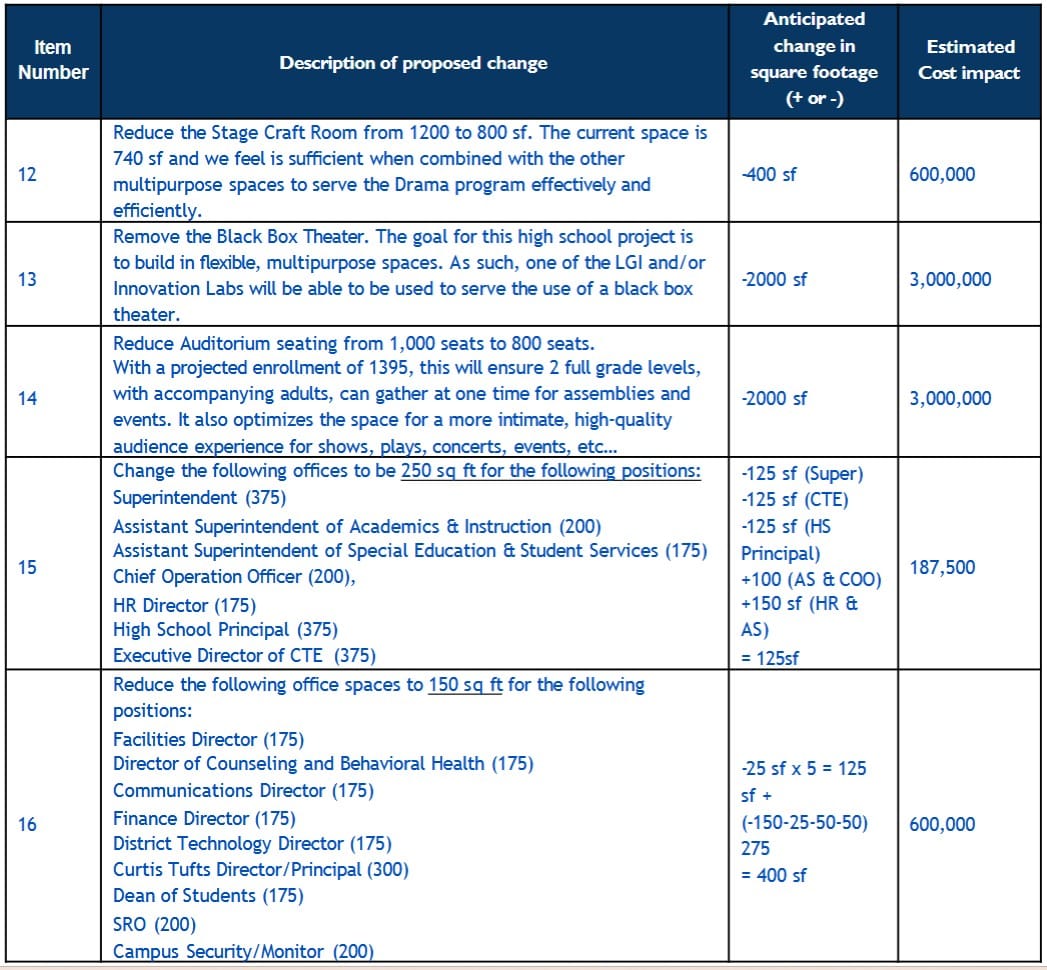
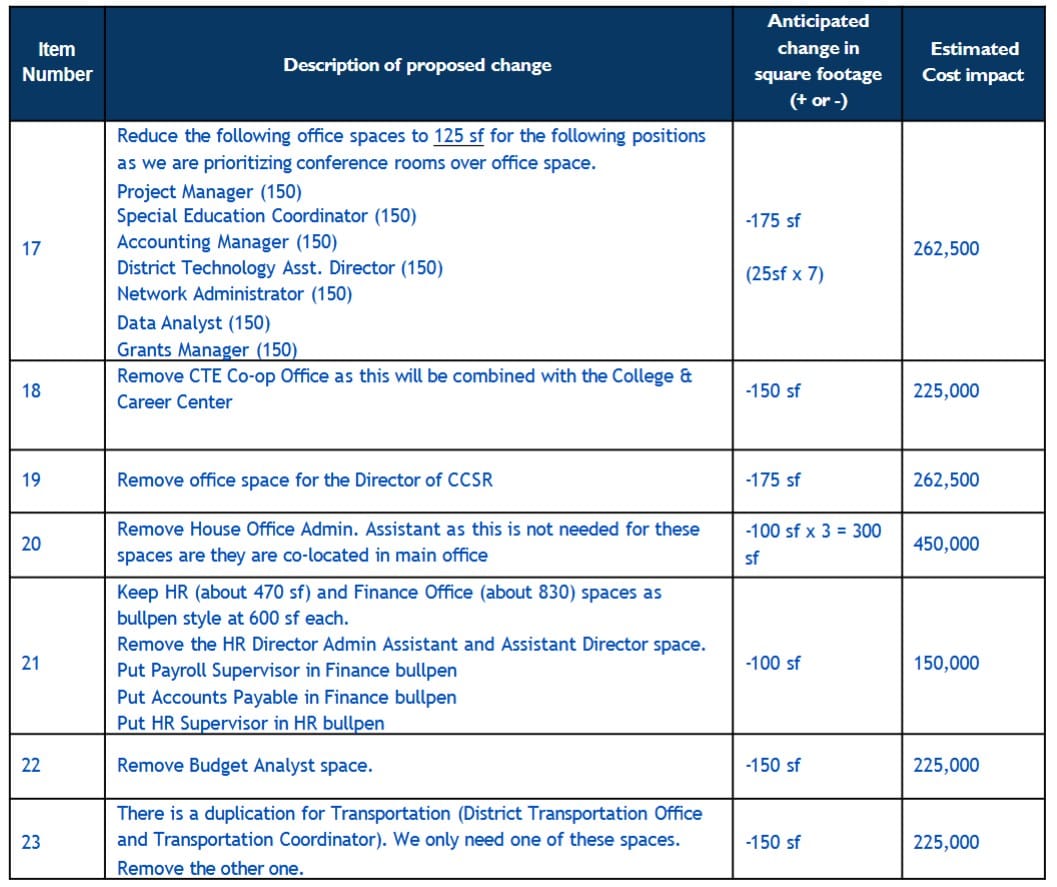
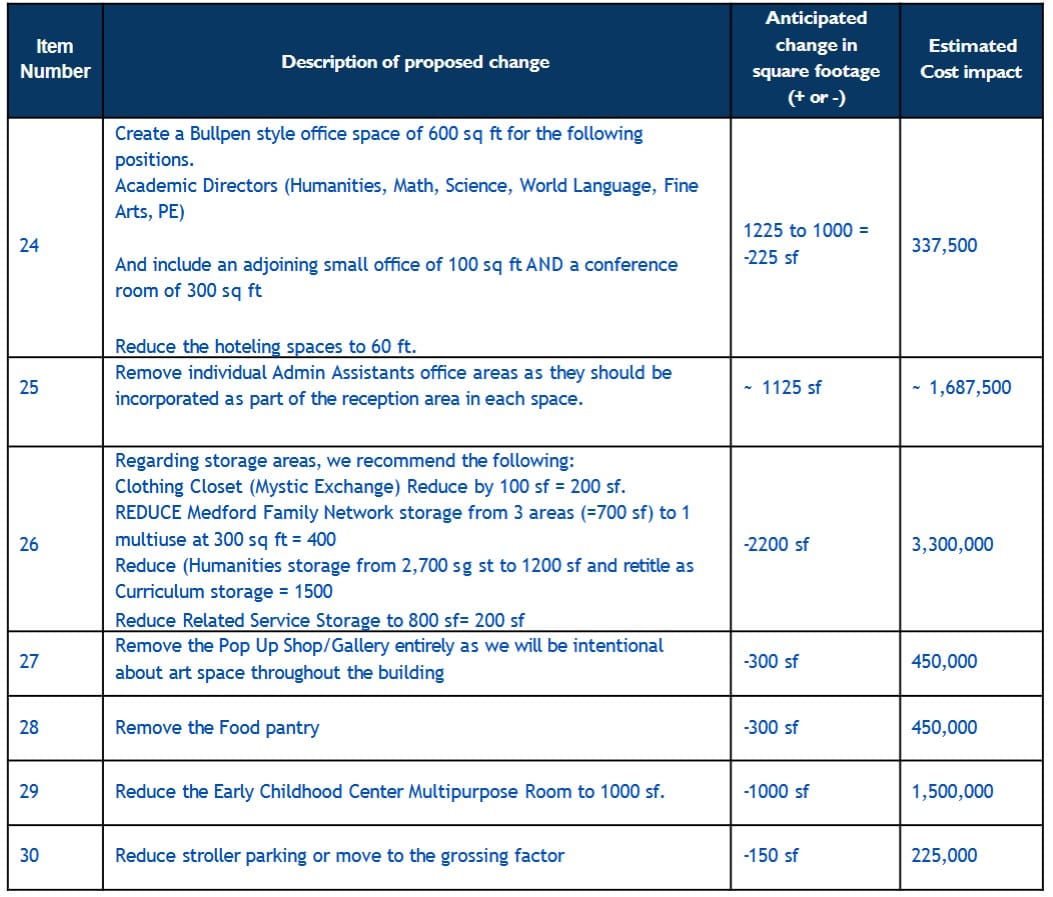
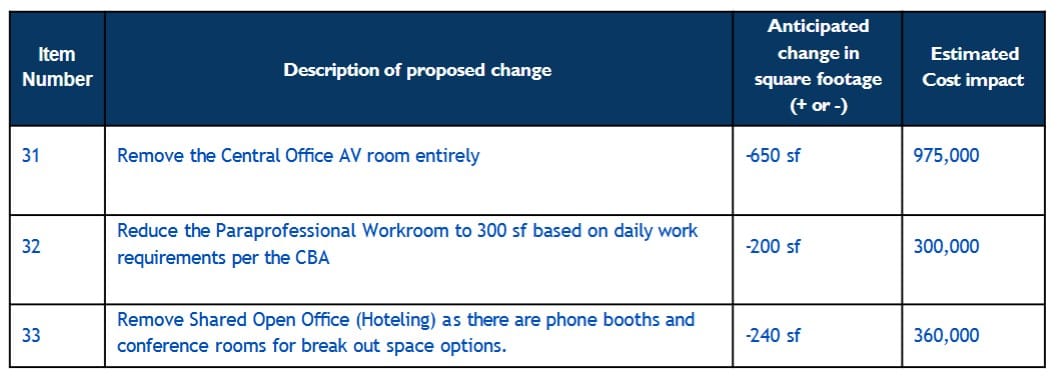
Galusi explained there were many areas that could be repurposed for multipurpose and flexible space to keep up with the demands of students and teachers. Additionally, there were many redundancies that were tweaked, she said, and any reductions were small and did not make an impact.
“Our recommendations are all aligned on our educational plan,” Galusi stressed.
After some further discussion, the committee voted to accept the removal of every item under Category A with the exception of numbers 3, 5, 6 and 14, which will be further evaluated for cost.
A motion was then made to table Categories B and C until the committee had better cost estimates to make additional cuts to space. Those estimates are expected by the next meeting on May 20.
On May 27, the city will present its financial information to the committee before a final selection of a design on June 10.
For full project information, check out the Medford School Building Project website.