Table of Contents
Residents did not hold back, nor did some members of the Community Development Board, when it came to giving their opinions on the latest rezoning draft for the Boston Avenue Corridor during a recent public hearing on the proposed changes.
“I just want to say I think it’s too much, too big, and way too many all at once,” said resident Dean Tognarelli, summing up the entire proposal for many.
What are we looking at?
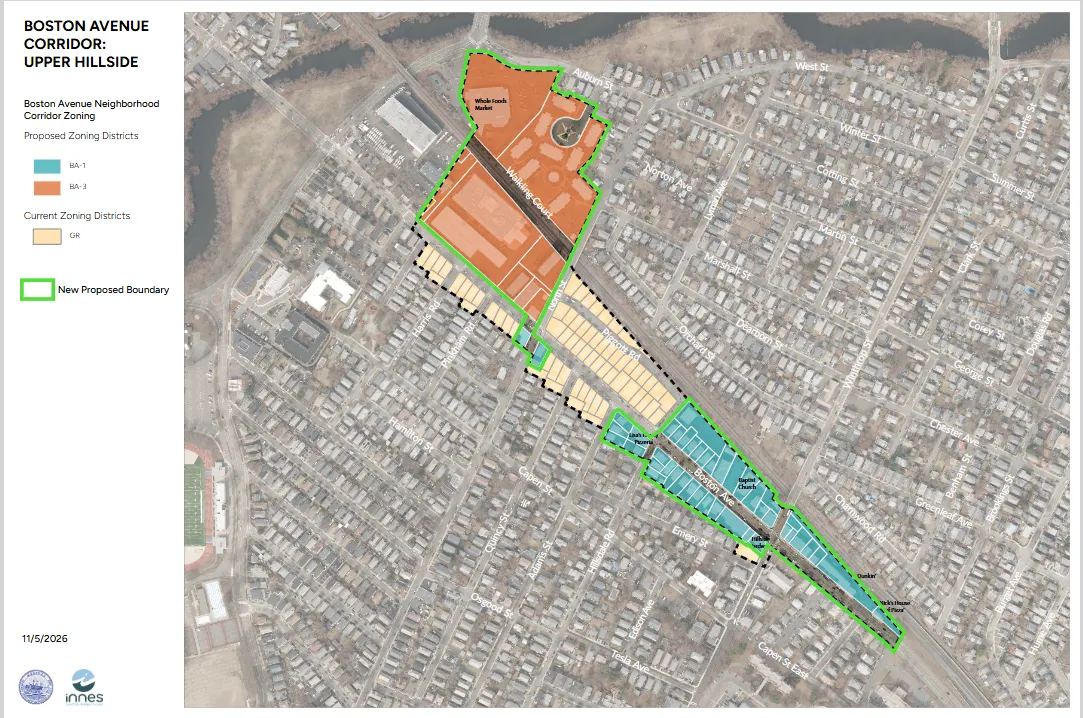
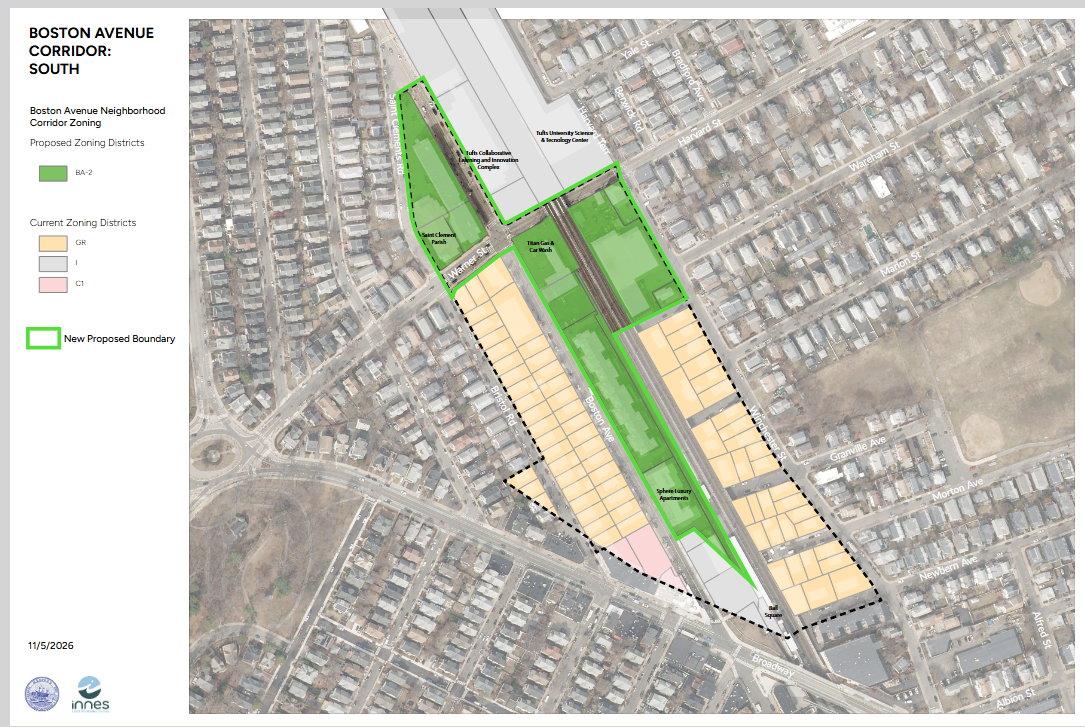
The proposal focuses on two areas: North Boston Avenue or Upper Hillside and South Boston Avenue.
North Boston Avenue covers from Whole Foods to just past Nick’s House of Pizza, but doesn’t include Walkling Court or a residential section off Piggott Road that falls in the middle. The South section runs from St. Clements Road and Harvard Street down towards Ball Square.
Boston Avenue (BA) is mixed use subdistricts that allow for a mix of residential and commercial with increasing sizes of scale, building sizes and mass.
The proposal presented by Innes Land Strategies Group allows for three stories (up to four total if projects provide more community benefits) in the BA-1 district around the Winthrop/Boston intersection, six stories (up to eight total if projects provide more community benefits) in the BA-3 district between Boston Avenue, North Street, and the train tracks.
Paula Ramos Martinez, chief resilience officer with Innes Land Strategies Group, said these heights are similar to what’s already there now.
The BA-2 district could see four stories (up to seven, if incentives are added) on a small number of parcels near the Boston Avenue and Harvard Street intersection next to the train tracks.
According to the proposal, “additionally, these maximum heights and masses would be further restricted by open space/green score requirements, daylight minimum requirements for adjacent properties, requirements for transitions to residential neighborhoods, setbacks, step backs, and other zoning provisions.”
The review
City Councilors did not have a lot to say about the project.
Councilor Anna Callahan raised the issue of parking requirements. She had received feedback from a resident helping with a home-sharing proposal, which Callahan is spearheading.
In her email, Roberta Camerson thought parking requirements should not be mandated for people who are home-sharing, essentially renting a room or two in their house. She worried that requiring an off-street parking space for lodgers would cause homeowners to forgo sharing their extra rooms.
And Liz Mullane wondered about the impact of a drive-through pharmacy on traffic in the area along Boston Avenue.
CDB members, however, had significantly more concerns, starting with Chair Doug Carr, who called it a flawed plan.
Both he and John Anderson were worried about preserving the historic neighborhood. Anderson feared if a developer can make more money tearing down a triple decker and putting up condos, that’s what they’ll do.
“And all over Medford, I’ve seen examples of where modest houses have been torn down and replaced by million dollar plus condos, so you’re not just adding density, you’re gentrifying when you do that, and I think that’s something we need to keep in mind,” he said.
Carr said the proposal seemed to be trying to extend the commercial boundaries of the area to make more of Boston Avenue a commercial zone. He also thought the heights were too tall, particularly in BA-3.
“It’s 98 feet at a maximum number with incentives,” he said. “That is only 9 feet less than the Tufts dorm that’s being built right now, which is universally described by hundreds of people I’ve met as the worst building they’ve seen in Medford, a complete disaster for Hillside … 98 feet to me is a bridge too far.”
He proposed maxing the BA-2 district at 70 feet and BA-3 at 85 feet. He also doesn’t think there is the foot traffic to support continuous retail along Boston Avenue. He would also like to limit the height of any potential redevelopment of St. Clements Elementary School.
“I’m not against zoning,” he said. “I want to just put it in the right place.”
Dina Caloggero agreed with much of Carr’s statements
Ari Gofman Fishman said overall they liked the project, but had some suggestions for tweaking the proposal.
They also differed with Carr on a few issues.
“I am overall a fan of higher heights, more density, and not as tied to preservation of all old buildings as Chair Carr,” they said. “This is a difference between us and I think is an area where there are different opinions around the city, and where reasonable people can disagree.”
Residents weigh in
Residents seem most concerned about building height and traffic density.
Tognarelli said that he heard people say there was an appetite for greater density.
“I would say, not if you live right next door, not if you're hidden in the shadow of a giant building, not if you have traffic for days or weeks or months upon end,” he said.
Resident Laura Longsworth advocated for removing fraternities and sororities as a potential land use in the area to keep them from further encroaching in the neighborhoods.
Laura Rumor agreed, calling it the heart of the matter.
“No fraternities and sororities should be zoned. Absolutely, no private dorms … they can go live somewhere else,” she said.
Anita Nagum took issue with the idea that it was okay to allow for taller buildings near the tracks. She said she lives on the other side of the tracks and it seems city officials have not considered how taller buildings might impact her neighborhood. She pointed to a project approved despite neighborhood concern that ultimately led to labs on the upper floors that have lights that shine into her home all night long.
“There is a huge privacy issue, and I'm not even as close as many people are,” she said.
She also objected to a suggestion one person made that just because an area is zoned for something doesn’t mean it will be built.
“Don’t zone it unless you expect it to be built,” she said.
Several residents asked both councilors and CDB members to walk the area to better understand how the proposal would impact them.
The Council and CDB will pick up the public hearing again Thursday, June 11 at 6 p.m. in City Council Chambers. The meeting will also be available via Zoom and live streamed on YouTube.