
Table of Contents
The wait is over! Medford residents finally know what their new high school will look like.
The Medford Comprehensive School Building Committee on June 10 voted 12-1 with two absent on its final alternative for a new high school building: C.2.2A. The committee chose the design after whittling down 29 alternatives to a final six in March.
The C.2.2A option will be built within the existing property, away from a deed restriction between the city and Department of Conservation and Recreation from 1967. Architects redesigned this option to keep it off those restricted parcels.
The building is expected to be six stories and include light renovation of the pool area and heavy renovation and construction of the remaining building. The design aims to support “future curriculum” and programs identified in the district’s Educational Plan.
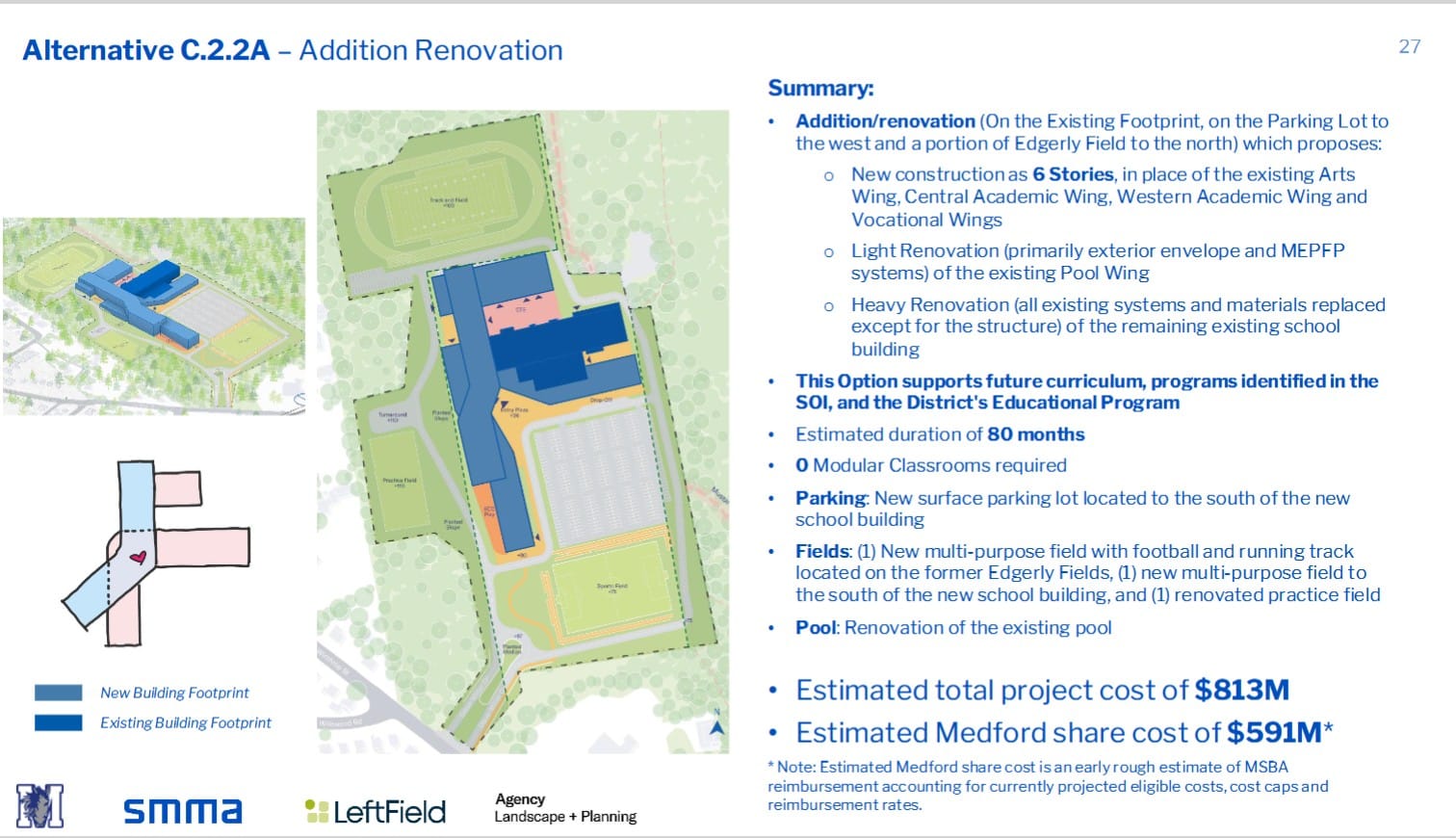
Estimated duration of the project is 80 months, with no modular classrooms required. This is an option officials and residents stated was optimal to keeping costs low.
The campus is expected to have a new surface parking lot and three fields, two new multi-purpose fields (a football and running track located on the former Edgerly Fields and a field south of the new school building) and a renovated practice field.
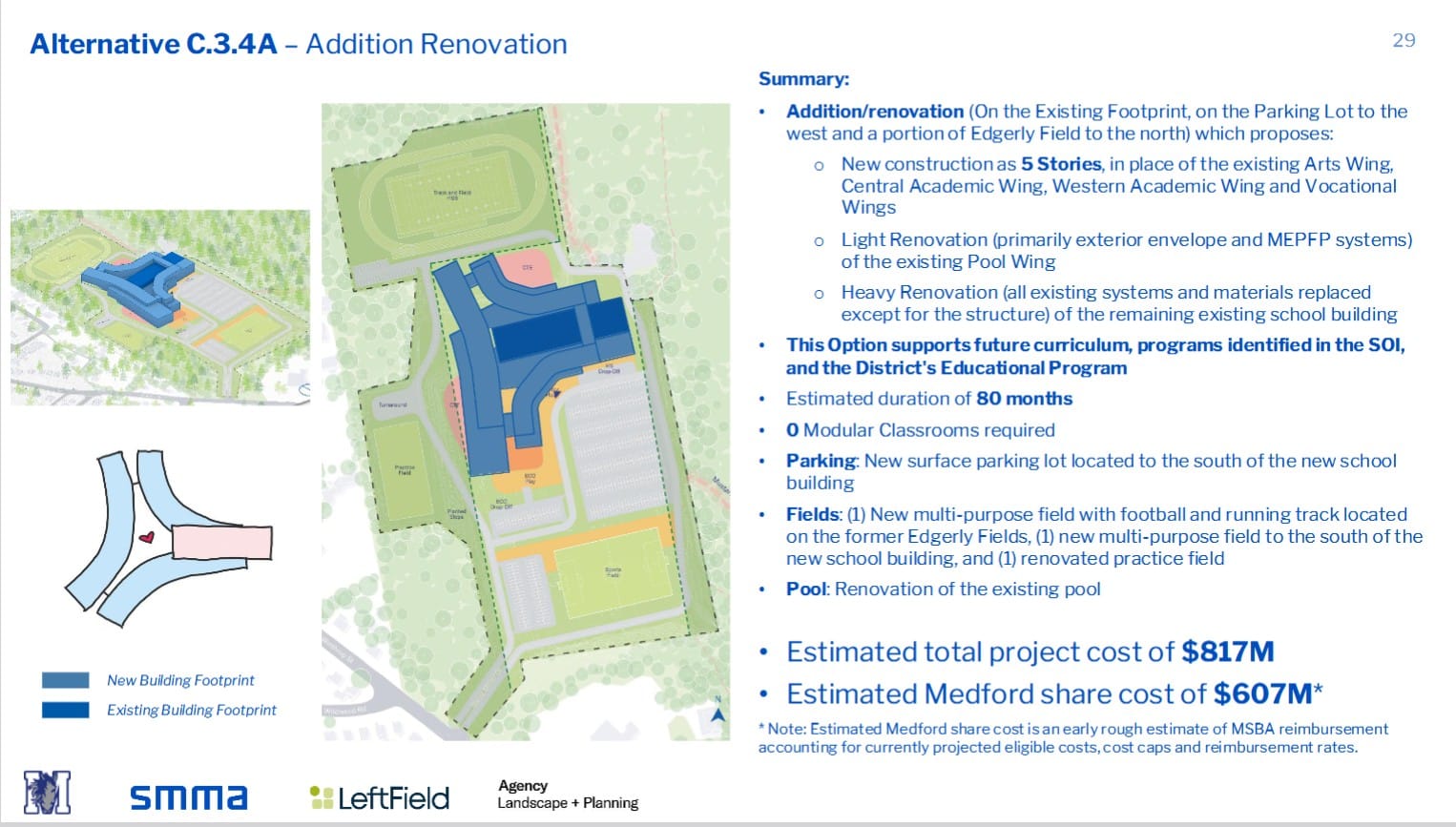
There is very difference in the makeup of C.2.2A from option C.3.4A, with the exception of layout and cost.
A recent report by architects costed the two as follows:
• C.2.2A: $813 million total project with Medford’s portion estimated at $591 million.
• C.3.4A: $817 million total project with Medford’s portion estimated at $607 million.
In a footnote, SMMA noted the “estimated Medford share cost is an early rough estimate of MSBA reimbursement accounting for currently projected eligible costs, cost caps and reimbursement rates.”
The debate
“For me, I felt like the committee was interested all along in the addition/renovation options (C.2.2A and C.3.4A) and it’s understandable why,” Chair Jenny Graham said, the day after the vote. “I felt pretty sure we were leaning that way.”
During Wednesday night’s meeting, the committee listened thoughtfully to reports from architects SMMA about the feedback it had received from recent forums, meetings and communications regarding all six options.
The presentation showed a clear preference by residents for the “C” options, with many comments supporting them ahead of any other designs.
Indeed, during public comment, residents and city officials on hand and online came out in support of those same two options, although many said they weren’t leaning heavily towards one or the other.
“I’ve been talking to my friends and neighbors and what I’ve heard is that both C options offer the most flexibility,” said School Committee member Mike Mastrobuoni, who was on hand for the vote. “I want to thank the committee for all your hard work and I’m very excited to get to the next step where we get to decide what goes into the space.”
During the committee’s debate, other options were quickly discarded for various reasons: police and fire officials felt the location had certain characteristics that were unsafe in case of an emergency situation (D.1.1); a renovation only option was too much money and not deemed feasible to meet future educational needs (A.1); and a high-school only design left out important programs such as the Medford Family Network and Kids Corner (C.2.2A-HS).
Committee member Libby Brown brought it back to the final two C options.
“With both C options, we will have a high school for the future,” said Brown.
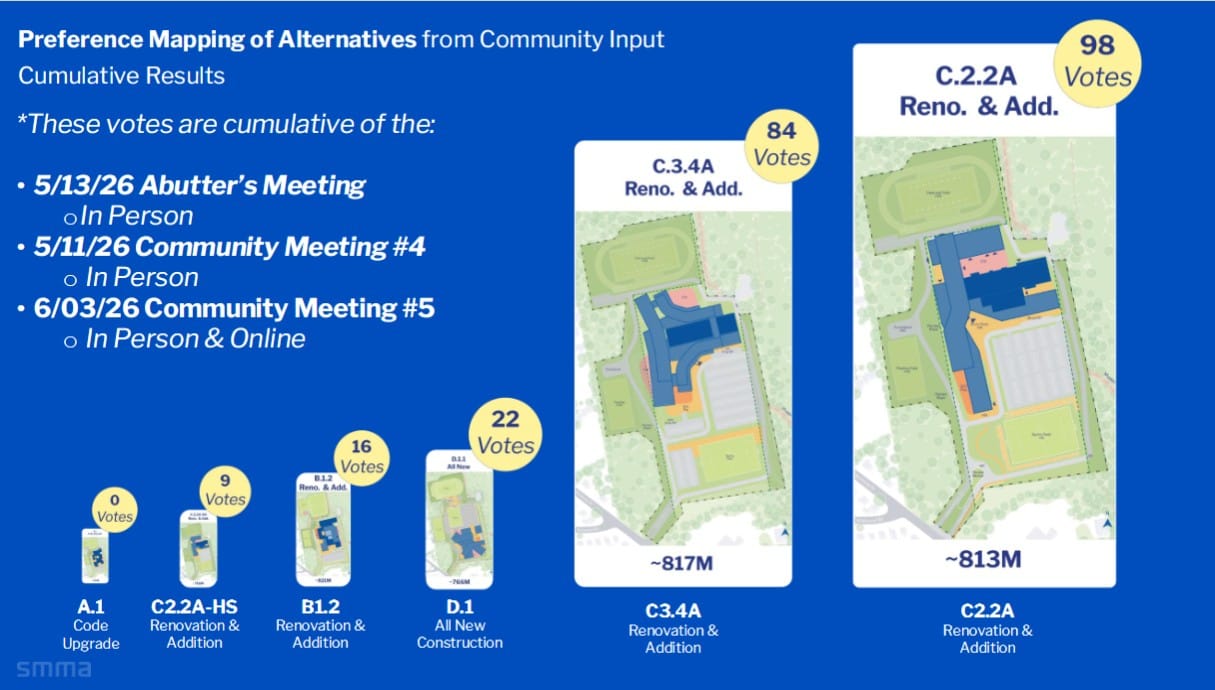
The final choice came down to the look and cost of the building. Some committee members pointed out the curves of C.3.4A might be difficult to work with and left inefficient spaces.
Medford High School Principal Marta Cabral agreed, saying C.2.2A allowed for educators to see down hallways more easily and provided a better sense of community for students and staff. She also said those dead spots in C.3.4A might cause security issues later on.
While the committee “circled around the Cs,” as pointed out by member Nicole Morell, it was Superintendent Dr. Suzanne Galusi that finally motioned for a vote from the group.
In the end, member Luke Preisner was the only no vote.
A day later, Graham said she really had no strong opinion between the final two designs. She said both spaces would have met the goals the committee set for the building.
“For me, the decider was the cost factor,” Graham said.
What’s next?
Graham said the numbers for the project still look high. However, she pointed out there is still a lot of work ahead for the committee and more decisions to be made that will have an affect on the bottom line — and that final number won’t be known until sometime next year.
In the meantime, she said the committee will meet again on June 18, where it will approve the Preferred Schematic Report (PSR).
That report is a study to be delivered to the Massachusetts State Building Authority by June 25 and includes everything the School Building Committee has been doing since February, from the selection of the original 29 alternatives, the process of whittling that number down to six designs, the feedback from the community, all the designs and information collected from SMMA and of course, the final decision.
The MSBA will review the report and during a board meeting in August, the Medford team will make a presentation based on the PSR.
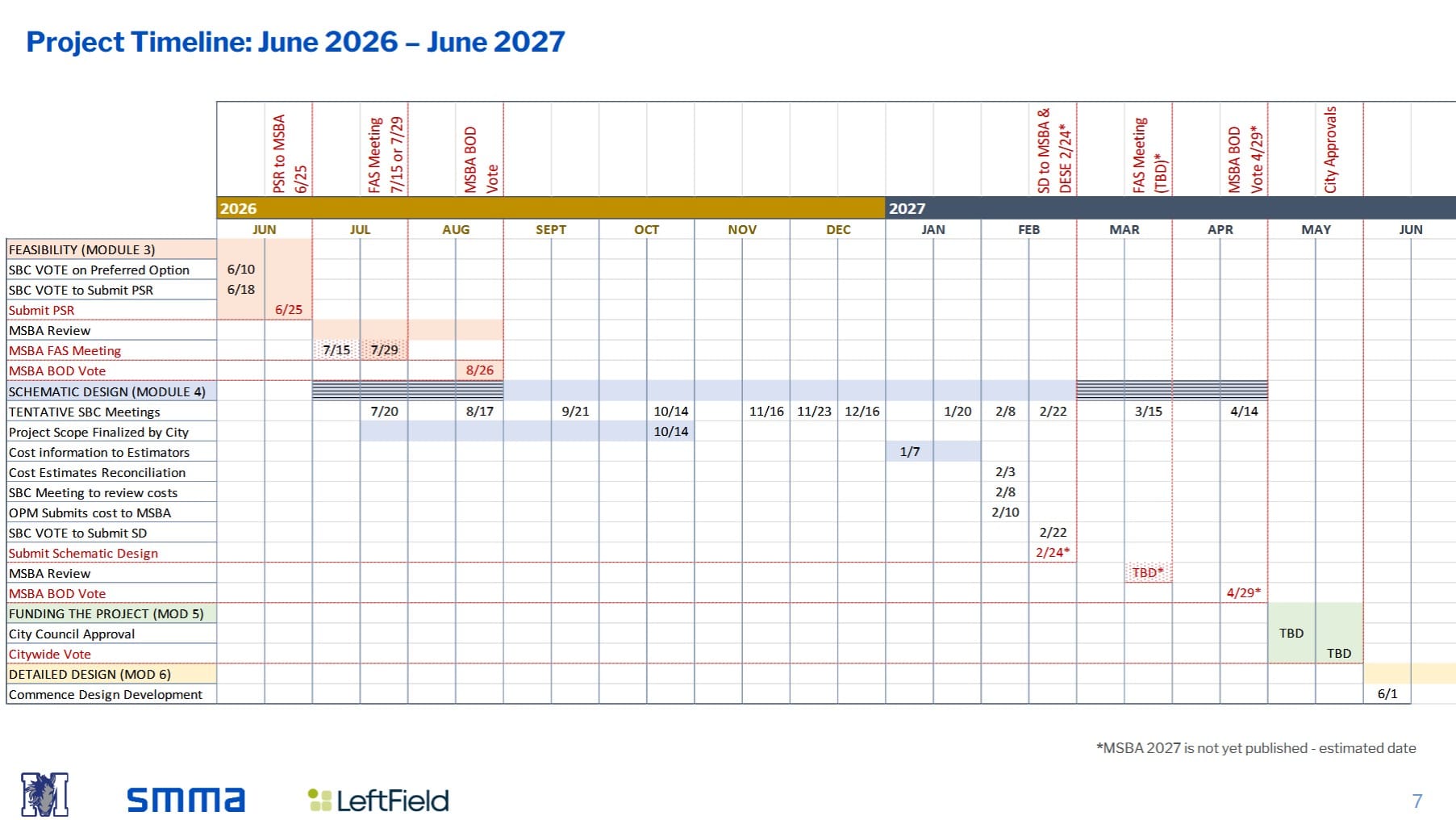
It will be at that meeting where Medford will receive the go-ahead to move on from the Feasibility Study stage to the Schematic Design phase.
“That’s when we will be doing a deep dive into everything about the building,” Graham said. “There’s still a lot of work to do.”
Graham said the School Building Committee will be meeting once a month through July and August unless something arises that needs immediate attention from the body, planning ahead for the next phase and setting a calendar that should take the project through next June.
“Once the submission goes to the MSBA at the end of June, we’ll take a quick break,” she said. “But we have a lot of important work to do over the summer.”
Meanwhile, Graham said everyone is talking about having the final building design. She added it’s exciting to have made the big decision.
“Everyone I’ve talked to says how exciting it is that we had a consensus around this option,” Graham said. “It was great to see that consensus.”