
Table of Contents
What will it take to run Medford’s schools next year, including new staff, more updated materials and funding for salaries and training? About $95 million.
How much are school officials asking for? Roughly $90 million.
If the numbers don’t add up, it’s a matter of financial constraints facing not only Medford, but about 1/3rd of Mass. municipalities, many of which are seeking millions in Proposition 2 ½ overrides to meet balanced budgets.
In neighboring Winchester, an $11.5 million override failed in March, forcing officials in that community to make drastic cuts to schools and services. Voters in Malden, which had never asked for an override, also killed two proposals for $5 and $8 million.
In the state’s highest ever override ask, voters in Brookline overwhelmingly approved $23.25 million over three years, of which $17.94 million will go to schools.
While Medford is also looking at a deficit in its books, that number only comes out to $1.8 million, which includes $240,000 for the Medford Family Network, $200,000 in raises for non-union employees, and $300,000 for an annual 2.75%-3% increase to the school budget.
And while Mayor Breanna Lungo-Koehn has been a long-time champion of the city’s schools, that annual increase just isn’t going to cut it.
During a joint meeting between the administration, City Council and School Committee on April 8, School Committee Vice Chair Jenny Graham called it “a confluence of events.”
“That 2.75% or even 3% is not going to be enough to meet our obligations in unavoidable costs that we’re carrying into ’27,” Graham said at that meeting.
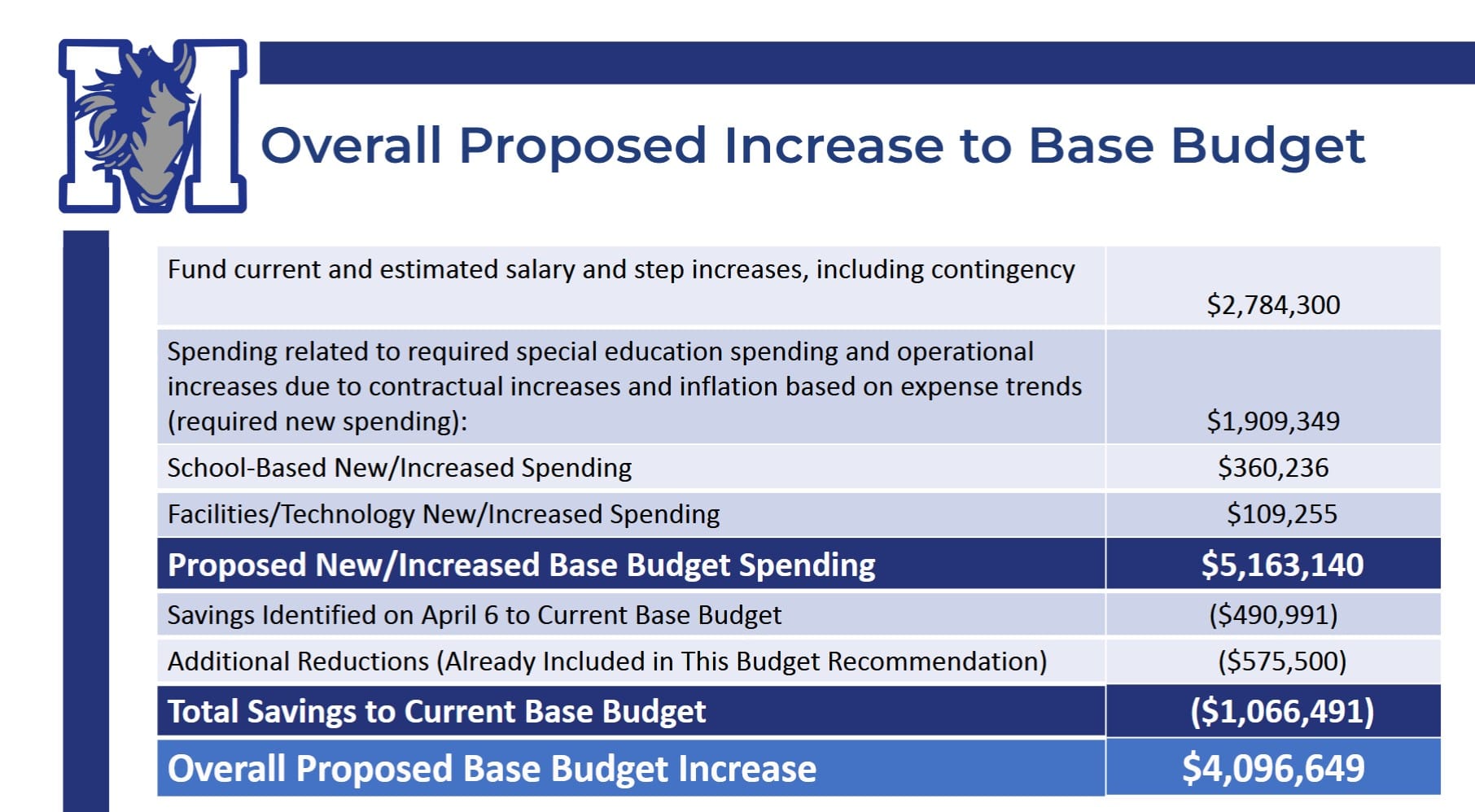
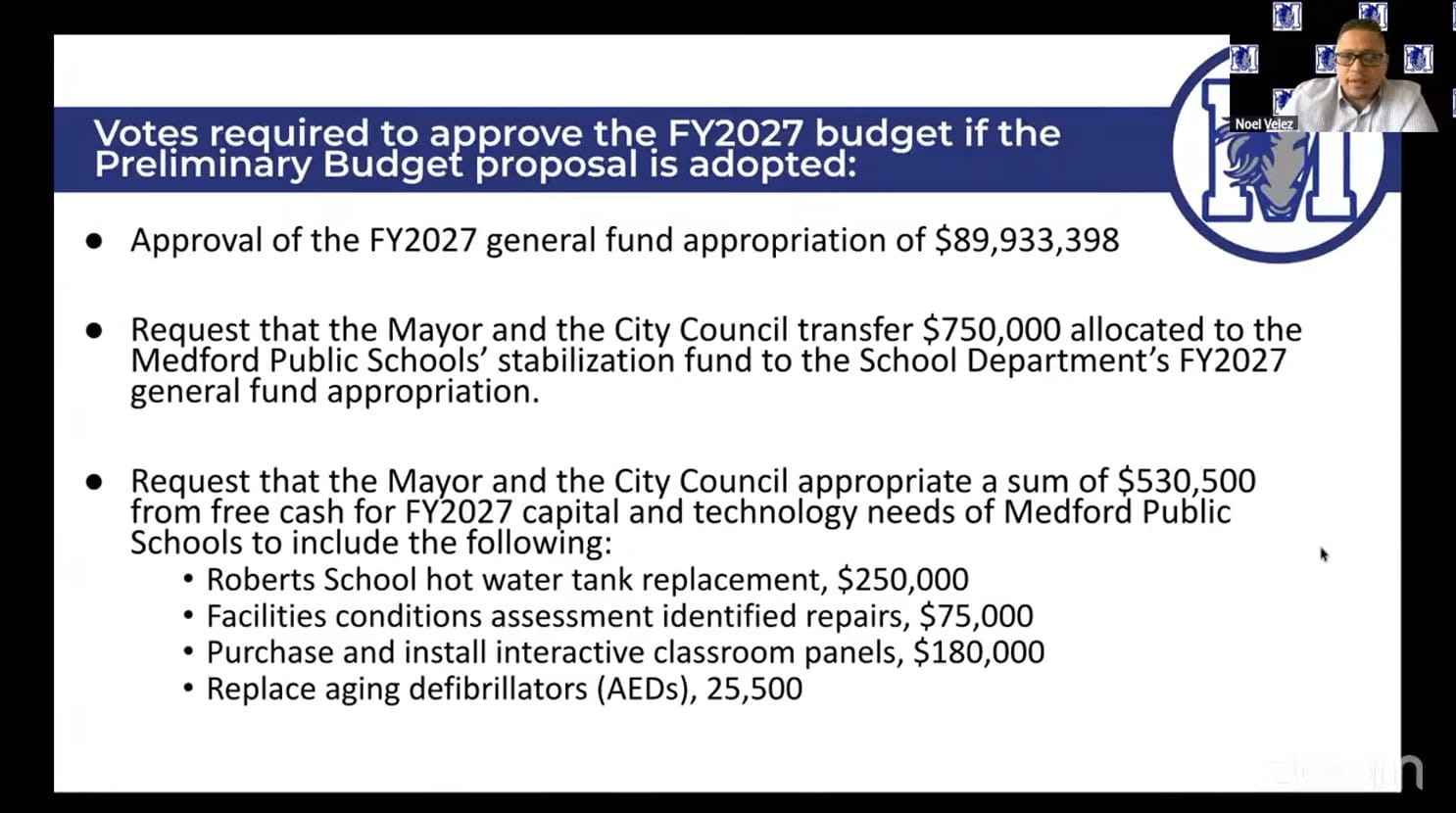
On May 12, however, the School Committee voted 6-0, with the mayor abstaining, to approve a request of $89,933,398 million for fiscal year 2027, as well as the following:
• A $750,000 transfer to the Medford Public Schools’ stabilization fund.
• A $530,500 free cash request for capital and technology needs for the following: $250,000 for Roberts School hot water tank replacement; $75,000 for facilities conditions assessment identified repairs; $180,000 for the purchase and installation of interactive classroom panels; and $25,500 for the replacement of aging defibrillators (AEDs).
What’s changed?
On April 6, Medford Public Schools Finance Director Noel Velez and Budget Analyst Gerry McCue came before the School Committee with a preliminary budget proposal of $94,032,696.
That number included more than $3 million in salary and step increases and $3 million in unavoidable costs, such as absorbing additional positions into the budget and increases in utilities, among a long list of expenses.
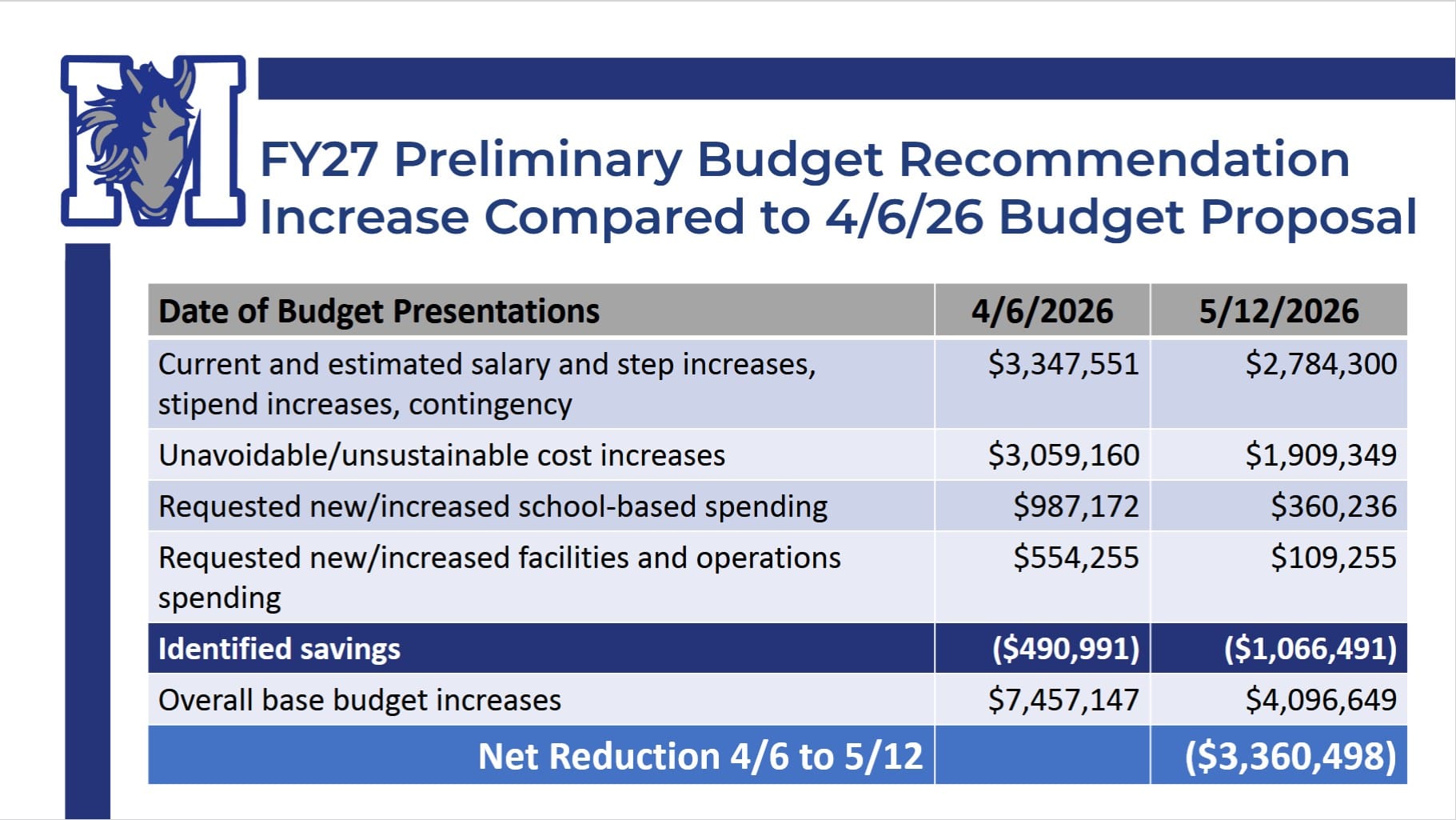
There were also requests for $987,172 for school-based spending for high-quality instructional materials and additional teaching support and for $554,255 in new or increased facilities and operations spending for contracted maintenance services and additional maintenance workers.
During the meeting, Lungo-Koehn said “the money is just not there” and said she would have to “wipe out half the city departments to pay for this.”
Since then, Velez and McCue have gone back to the drawing board, wiping out $3,360,498 from the school’s fiscal 2027 budget, bringing the number down to $90,683,398.
That’s still about $2 million short of what the city would like the number to be.
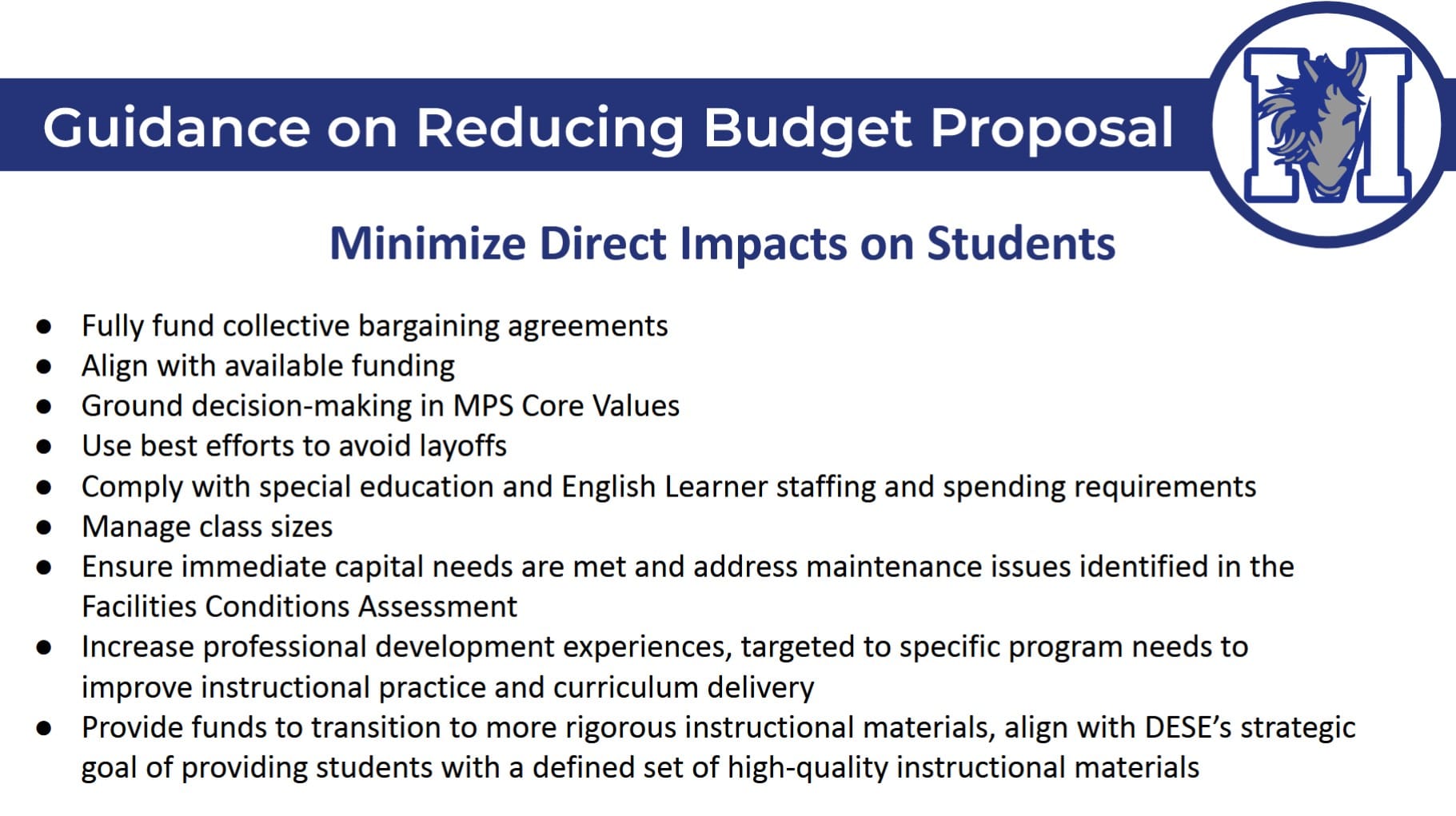
During a May 12 meeting, Velez and McCue said they went back over the numbers, being very careful to keep several things in mind, including how to “minimize the direct impacts on students.”
But what does all this really add up to? Reductions and deferrals for 2028.
It means: not hiring for positions left vacant from retirements and moving teachers around to fill those positions; not funding a long-awaited inclusion specialist in special education; not moving positions from revolving accounts onto the main budget; paying positions and programs from state grants; eliminating the Yellow Bus due to low ridership; and cutting back on materials for teacher training and students.
Both Velez and McCue, however, said there still needs to be new spending in order for the schools to run. This would include adding a new teacher for first grade at the Missituk and adding teachers at the Curtis Tufts.
Superintendent Dr. Suzanne Galusi said this budget cycle falls into “a year of significant progress” for Medford as the leadership team continues to make changes at every level of the city’s schools, such as adding 15 more minutes of instruction time or consolidating schedules.
But cuts do have to be made across the board.
“These are the realities of the current economic landscape,” Galusi said. “And like many districts across the commonwealth, we are negotiating unavoidable rising costs in special education, transportation and general operations.”
She added the entire administrative team has been gathering public feedback on what matters most so that Medford meets the needs of its students.
“We are moving towards a unified vision that ensures all resources support our shared educational and operational goals,” she said.
What’s next?
Despite a thorough review of the budget, School Committee members had questions about what’s being cut and why.
Graham said she was disappointed to see the inclusion specialist position cut, especially since that was one of the earmarks of Medford’s previous override.
“Parents of special education students have been anxiously awaiting that role to be filled and it’s been a very long time,” Graham said. “I don’t think the need is going away and, in fact, they would tell you, if you ask them today, that there’s even more of a need than there’s ever been for that kind of role, particularly in the Project Transition program.”
Galusi said the inclusionary specialist remains a “100% priority,” but added it’s been “tremendously difficult to fill” and that the schools have not been successful in finding a qualified candidate. She added she’d like to take a “thoughtful pause” on how to better post the position to draw the right people to the district.
Additionally, School Committee members asked about sports fees and transportation for arts programs, which the district has been trying to build.
Galusi said there has been a 300% increase in music and fine arts and that Medford is looking at ways to continue to build its programming, given that the educational plan for a new high school includes space for such classes and activities.
School Committee members also wanted to know just where the budget is and what the gap continues to be.
Lungo-Koehn said the city staff has been meeting with not only the School Department, but every other department in the city.
“We’ve been going line-item by line-item,” Lungo-Koehn said of the budget process. “We’re halfway through and we’ve cut costs on the city side of the budget. We think we can fulfill the schools and MFN.”