Table of Contents
By Crystal Yormick | Correspondent
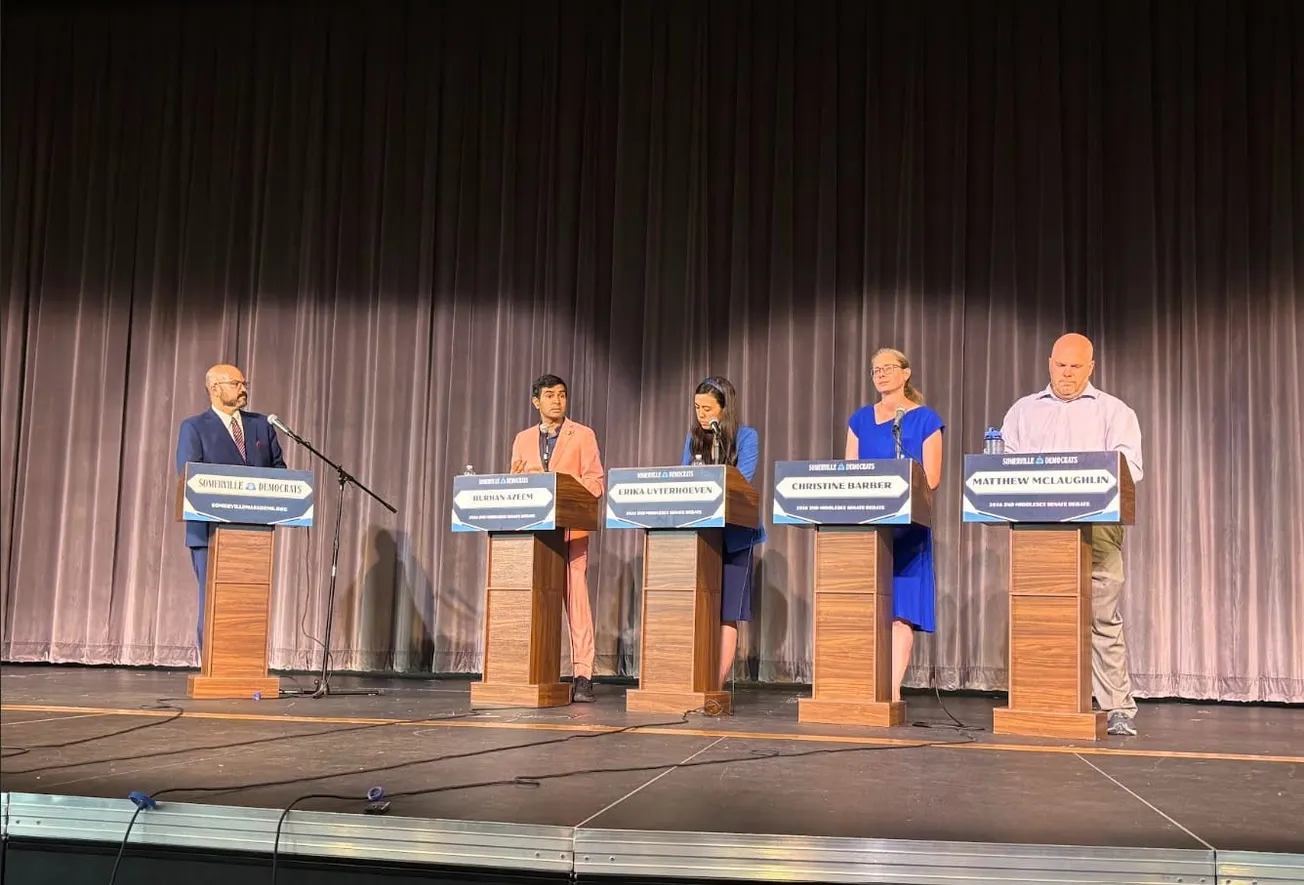
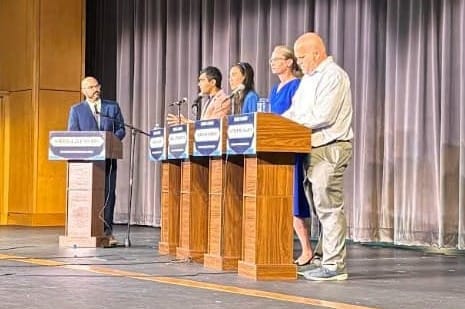
Candidates for the 2nd Middlesex District Senate seat debated their approaches for housing, utility costs, affordability and legislative styles at the Somerville High School Auditorium on Saturday, Aug. 1.
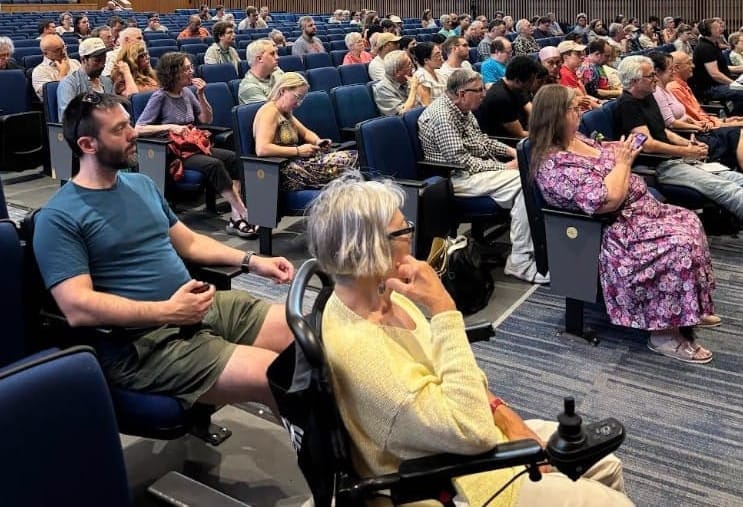
Over 100 residents from all over the district attended the event hosted by the Somerville Democratic City Committee.
Four candidates remain in the race: Rep. Christine Barber, D-34th Middlesex, Cambridge Vice Mayor Burhan Azeem, Somerville City Councilor Matt McLaughlin, and Rep. Erika Uyterhoeven, D-27th Middlesex. Winchester School Committee member Tom Hopcroft suspended his campaign over a month ago.
The debate followed the structure of the July 16 debate. Candidates gave three-minute opening statements and then had a minute and 30 seconds to answer each question, with 30 seconds for follow-up answers. They finished with two-minute closing statements.
Following are the questions asked by a moderator. The questions have been edited for length and clarity. Following each question are summations of the candidates' remarks.
QUESTION: How have you personally drafted or been the lead sponsor on a bill or an ordinance that then became law, and what was the impact? What did you see change for your constituents?
Azeem: Rewrote the entire zoning code in Cambridge to make room for more triple-deckers and affordable apartments. Everyone banding together and putting up with some of the negative side effects would put a real dent in the housing crisis, he said, and be a compelling message on a state-wide level.
Uyterhoeven: Filed and passed an amendment to reduce the impact of the most regressive item on a bill that proposed to cut taxes by $1 billion and stopped a corporate tax break. Passed the broker’s fee ban and doubled affordable housing funding in Somerville using the Community Preservation Act.
Barber: There is a difference in filing a bill and actually passing it, she said. Passed a bill that allowed people to have drivers licenses regardless of their immigration status, which was politically risky. She worked with the Work and Family Mobility Coalition, built support and sat down with colleagues to see what they needed to get them to vote on the bill over years. Had enough votes that when Gov. Charlie Baker vetoed it, they overturned the veto. This has laid the groundwork for fighting ICE-related issues.
McLaughlin: Instigated Somerville’s charter reform, which “overhauled” the city government and increased transparency, he said. He got community input, had negotiations, and some fights with other leaders, but found compromises and got it passed. He also introduced Narcan to Somerville when no one knew what it was because he is “grounded in people’s reality.”
QUESTION: Moving on, the MBTA. Vice Mayor Azeem, do you think it’s important to consider the larger scale projects like this when thinking about improving regional transportation, and how do you propose to finance something that is on that scale?
Azeem: Need to expand the Red Line and the Green Line. For most of T’s history, it’s been in a good place, so the funding formula should go back to what it was prior to 2000 to fix the funding formula or implement a two-cent sales tax instead of one.
QUESTION: Rep. Barber, you’ve been focusing on fare-free buses. That’s a very different proposal than infrastructure expansion. Estimates there are about $100 million to essentially make buses free for the MBTA. Why are you focusing on that scale of solution?
Barber: Mobility is very important. There were fare-free bus pilots during the COVID-19 pandemic where people saw a lot of the benefits, like increased ridership, less queuing, and buses being on time. It also saves money because there is no expensive infrastructure for credit cards and Charlie cards. It would cost a couple 100 million, but is doable by funding it with money from the millionaires tax and another bill she filed to close corporate tax loopholes.
QUESTION: I don’t want to move off the T without opening it up to any other rebuttals. So Rep. Uyterhoeven or Councilor McLaughlin anything on the T?
McLaughlin: Goal is a 10-minute wait time for any bus lane in Cambridge, Somerville or Winchester. Instead of taking bus lanes away, the city should invest in them and prove to be a model for the rest of the region, he said. He would also love to see the T expand into Arlington and Medford and he supports fare-free buses.
Uyterhoeven: Make the buses fare-free, expand capital investments, expand the light rail and catch up on deferred maintenance. She filed legislation to study the cost of a full fare-free bus system. Need to look at how to raise “progressive revenue so we have a reliable, safe and frequent fast transit across the entire system,” she said. Follow Paris, France, model of making the system fare-free?
QUESTION: Councilor McLaughlin, how do you use your office, your time, in [Somerville] City Hall, to effect especially local zoning? Maybe walk us through your experience when it comes to the policies that need to be in place to solve this.
McLaughlin: The housing crisis is falling on cities like Somerville to solve it because other cities are actively resisting it. Introduced the Triple Decker ordinance in Somerville, which allows three-family housing to be in compliance with the MBTA Communities Act. Built affordable housing in the most densely populated city in the region and a lot of these ideas have spread to Medford, Cambridge and beyond, he said. Has fought elected officials when they opposed affordable housing. When he wasn’t able to get things done, he got progressive candidates to run for office and “we changed this entire city,” he said.
QUESTION: Vice Mayor Azeem, I assume there’s similar problems in Cambridge. Walk us through how you have worked with zoning, with the housing issue in Cambridge.
Azeem: Founded Abundant Housing Massachusetts and supports the Welcoming Neighbor Network, which he said was key in getting the "ROAD to Housing Act" passed at the federal level. Introduced the starter homes ballot question, which would lower the amount of square footage needed for a single family home. If this is lowered, the state could build homes “without having ugly fights,” he said.
QUESTION: Rep. Barber, working at the state level, how’s your experience been? Give us that perspective.
Barber: Somerville is living the housing crisis, she said, and touched on her experience as the only candidate who is also a renter. Passed a tenant "right of first refusal" policy in the House of Representatives so tenants have a certain amount of time to buy units if they're in a building the landlord is selling. Authored the ADU law and doubled funding for HomeBASE, a program that keeps people out of shelters and into supportive housing.
Uyterhoeven: Home needs to be affordable, climate resilient and built by unions. Been fighting for the transfer fee to level the playing field between people who are trying to buy their first home here. Developers have a big sway in housing regulation because they put a lot of money into campaigns, which needs to be addressed, and she is not taking any developer money, she said.
QUESTION: One of the other sides of the affordability coin is utility costs going up in Somerville and in elsewhere. I’m going to stick with you Rep. Uyterhoeven because you’ve been calling for more public investment in renewable energy, stronger regulations of utility companies, issues that we hear about a lot. What is the single most important action the legislature could take to lower utility bills within these next two years?
Uyterhoeven: Addressed it from short-term and long-term perspective. A lot of a utility bill goes to delivery fees, which she referred to as “junk fees,” that need to be addressed and lowered. Need to be building publicly owned renewable energy to figure this out long-term so there is a clean renewable transition that is union built that also lowers energy bills.
QUESTION: Is there one thing the state should be doing or can do to lower bills in the next 10 years?
Azeem: Have the third highest utility costs in the country, and transparency is an issue. The cause is usually poorly written legislation.
Barber: End the Gas System Enhancement Program and shift away from new gas pipelines to renewable energy sources. Been leading the fight for fossil-fuel-free pilot in Somerville so new buildings would be taken off fossil fuels. Saves the climate and saves money, she said.
McLaughlin: Long-term solution is mass-scale renewable energy to drive down costs. Have to fix the issues we have right now for gas leaks and infrastructure issues.
QUESTION: Perhaps the most important vote on Beacon Hill will be the first one for legislative leadership. How will you evaluate the state Senate presidency? If you know the incumbent Karen Spilka is going to stand again for re-election to the presidency, what will you look for in evaluating her and her leadership team?
Azeem: The sense in politics is that you have to agree on everything, but it is important to him that not everyone in the State House agrees on every issue. It’s important to have people who are critical of passing policy because passing policy is hard but “you have to land on something.” The public pushes policy along.
Follow-up question to Azeem: Is the conflict that you’re speaking of happening inside the Democratic caucuses or would you take that to the floor and vote against leadership?
Azeem: Depends on the details, but he is happy to use “every tool and every opportunity to get to a better place,” he said, which can happen in the caucus and also the general floor. He is not afraid of a tough vote “here or there.”
Uyterhoeven: Has voted both for and against the speaker. They are there for issues, that’s what representatives are elected to fight for, she said. Is very critical of the “wait and see” culture on Beacon Hill. Wants to ensure representatives can respectfully disagree. Is hard on issues and clear about what was good and what wasn’t in legislation. Can’t say how she would vote today but would base it off conversations with every member of the Senate.
Barber: Organizing model of developing relationships and building progressive power with people like her, and also people not like her. Building relationships with people from rural areas, Republicans and people with different backgrounds. Wants to be a leader and work with others to make sure they are collaborating and connecting with the community “to fight and get the best results that we possibly can,” she said.
McLaughlin: Points to relationship with the Somerville mayor because he’s had some political fights with him, but they are on good terms. “He’s supporting me in this race because he knows that I’m a principled person who cares about my community,” he said. Not afraid to fight with Mayor Jake Wilson. Have more power to do what he wants as a state senator and he’s going to work with the other representatives, tell them what he believes and won’t hesitate to vote against their interests if it conflicts with the interests of the community. Would not do it out of spite but out of principles because “it’s rooted in bettering the community that I serve,” he said.
The primary election will take place on Tuesday, Sept. 1.