

Youth Risk Behavior Survey: Medford students doing well overall, problem areas identified
School officials are sharing information from the Youth Risk Behavior Survey, which provides student data on a variety of mental health issues.

The good news is 77% of middle schoolers and 81% of high school students report they have at least one trusted adult at school they can talk to, and 90% of both have a trusted adult in their family. That’s way higher than the state averages of 64% and 76%, respectively.
And if you’re wondering why that matters, it’s just one very important piece of the data school officials garnered from last year’s Youth Risk Behavior Survey (YRBS).
Dr. Stacey Shulman, director of school counseling and behavioral health, and Catherine Dhingra, manager of the Office of Prevention Outreach for the city, presented school officials with the results of the survey earlier this year.
This is the first year Medford has used the YRBS, having used a similar survey called Communities that Care since 2017.
Dhingra said the decision to make the switch was done in summer 2024 because the YRBS is used by the state and by many communities, especially those surrounding Medford.
In spring 2025, Dhingra said Medford secured grant funding for an outside evaluator who takes the raw data and puts it into a report.
The data is then used by city and school officials to assess current supports for students and families and come up with new or additional programming.
The YRBS is administered every two years during the spring to grades 6-12 and covers eight categories: safety, discrimination, violence-related behaviors and experiences, mental health, substance use, sexual behavior, physical activity and nutrition, and protective factors.
Questions are based on the Centers for Disease Control and Prevention’s Youth Risk Behavior Survey and the Massachusetts Department of Public Health Youth Health Survey.
Superintendent of Schools Dr. Suzanne Galusi said there were some explicit questions on the survey, which the district adapted for its students.
In Medford, there were 674 middle school participants, with 143 incomplete surveys and a number of exclusions. The final total for the Andrews and McGlynn was 531 students.
At the high school, 742 students participated, with only 71 incomplete surveys, for a total sample of 670 students.
The high school also held four focus groups to speak to students about the survey, with 22 participants, who talked about school culture, frustrations and finding ways to become more active and engaged in making changes.
What does all this mean?
Overall, both Dhingra and Shulman were pleased with the data from the YRBS, including these highlights:
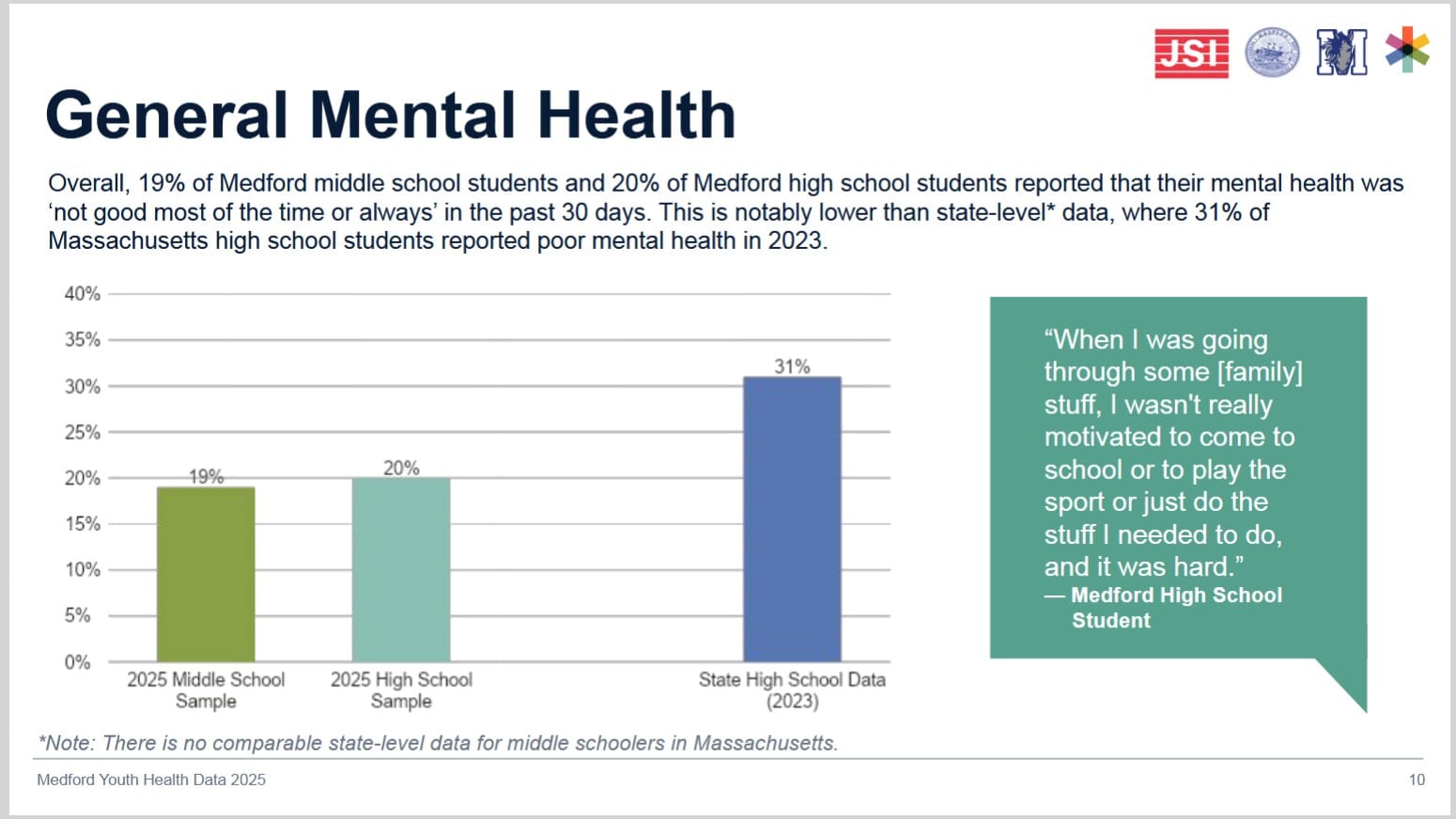
• 19% of middle schoolers and 20% of high schoolers report their mental health was “not good most of the time or always” in the past 30 days. That is lower than the state average, where 31% of students reported poor mental health in 2023.
“I was very surprised,” Shulman said of the result. “The Medford data is better than the state so I was pleased to see that.”
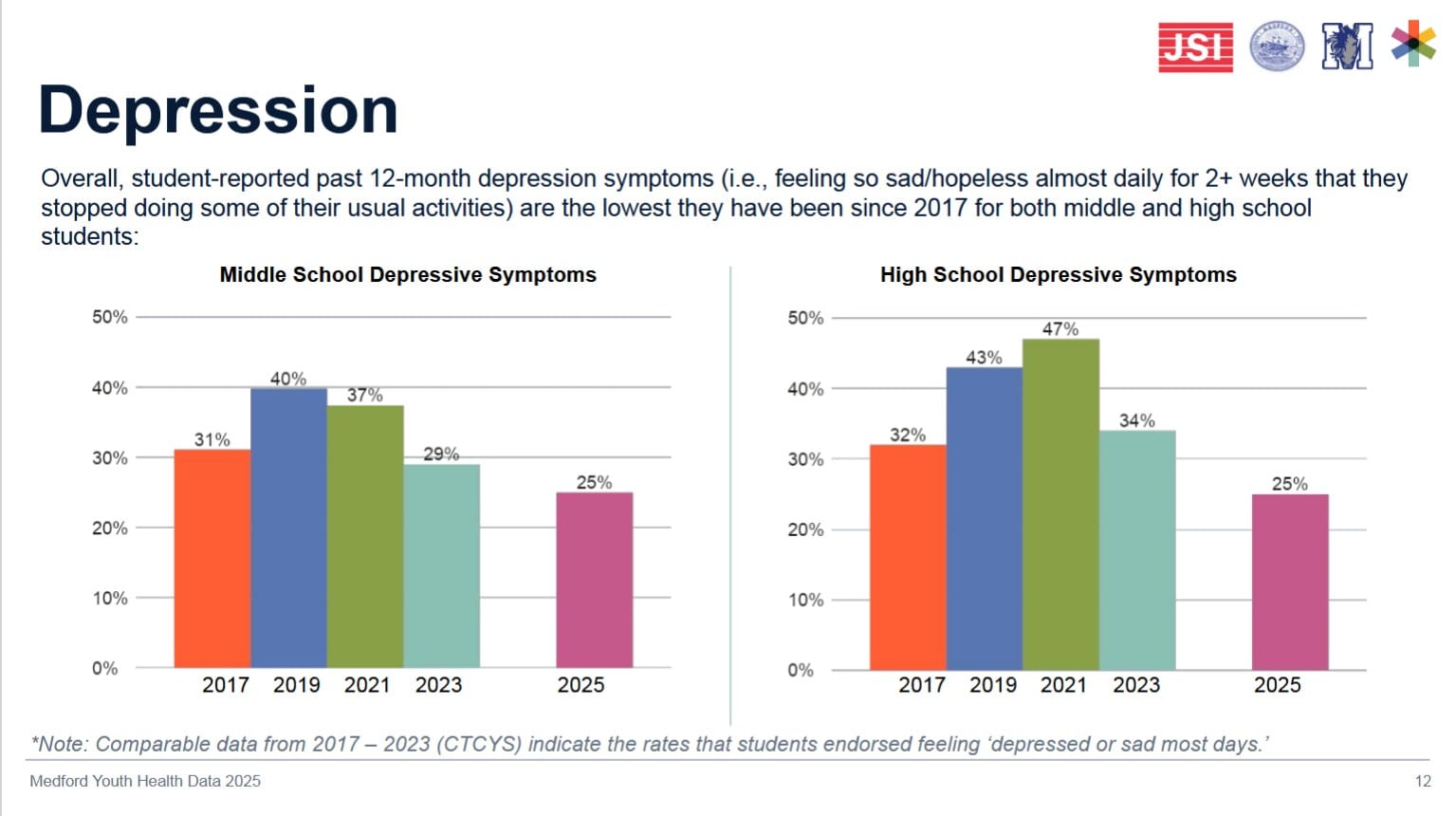
• Depression among students is at its lowest since 2017, with only 25% of students self-reporting they were depressed. It was a “notable decline” in the data.
• Substance abuse rates in youth are on the decline, with only 3% of middle schoolers and 11% of high school students reporting they were using alcohol.
• 83% of high school students and 87% of middle schoolers report they feel safe in school, although both Dhingra and Shulman said Latino students are not exactly feeling safe due to concerns over ICE.
• Bullying has declined on school property, with 10% of high schoolers reporting such activity and 36% of middle schoolers. Online bullying remains a problem, with 14% of high school students reporting the problem and 29% of middle schoolers.
Where are the hot spots?
Vaping continues to be a very big problem in Medford schools.
Galusi said she was surprised by this, given all the work the district has done.
“It’s an ongoing challenge bringing awareness to students about vaping,” Galusi said. “We’ve done a lot of work to educate students and we’ve made a lot of progress through our partnerships with Catherine [Dhingra].”
Plus there are vape detectors in the bathrooms, she said, with more on the way this year.
“That will mean all the middle school and high school bathrooms will have vape detectors,” Galusi said. “We will be able see, via cameras, who’s coming out of the bathrooms and speak to them. We can’t always prove they have a vape on them and are using it because they can be very good at hiding it.”
That just means working to implement more strategies, Dhingra said, adding students “perceive the risk of harm in prescription drugs, smoking and vape use, but they also perceive there’s an easy access to alcohol and vaping.”
Dhingra said Medford will likely implement multiple tiers of strategies around substance abuse, including intervention and referrals to wellness programs. And, she added, the vape detectors are definitely working.
“Students talk a lot about them,” she said.
Shulman said students see it as a “healthy alternative” to smoking. But Medford has an educational program called Catch My Breath centered around vaping, and she hopes it will educate students like the public health campaign around smoking did over several years.
What else?
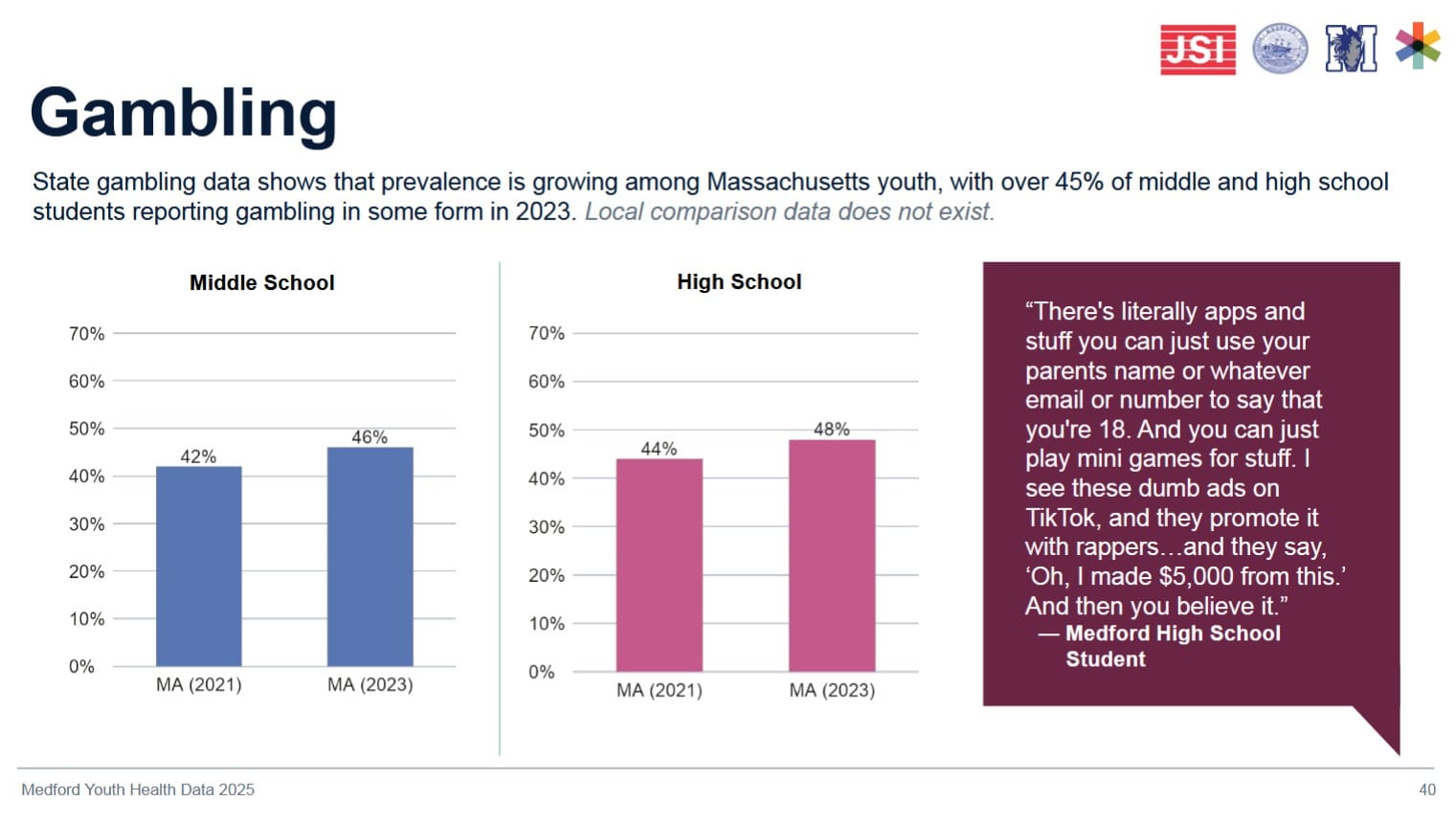
Gambling is another area where there’s a huge issue, not only in Medford but statewide. In 2023, Massachusetts reported 46% of middle schoolers were involved with online gambling of some sort while 48% of high schoolers reported the same thing. Those numbers increased from 2021 by 4% in both middle and high school.
The question is, why?
“It’s everywhere,” Shulman said, adding she was recently at a Bruins game where the scroll around the top of the arena announced that patrons should place their bets on Draft Kings. “It’s become part of the culture. Kids see someone in their family playing online games and there are apps or video games with built-in gambling behaviors.”
Dhingra said there was a lot of excitement across the state when online betting was allowed. She said that during a recent focus group, a student openly tried to convince other students they gamble more.
“That really shocked our staff,” Dhingra said. “We really want to do more to help provide access to people around this issue. The city has to do more preventative work.”
Medford is already working to provide workshops around mental health and other issues for residents, one of which is gambling and online sports betting.
Continued supports
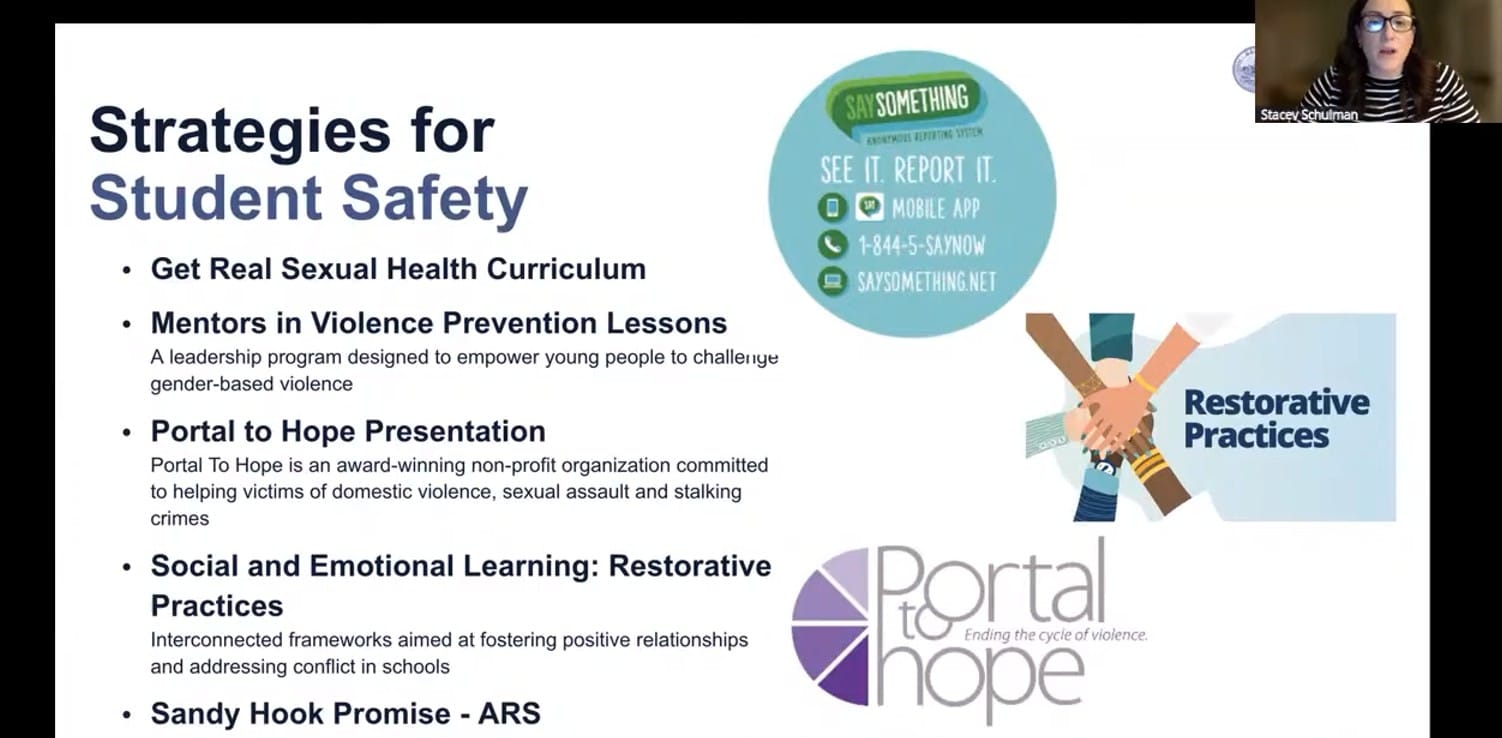
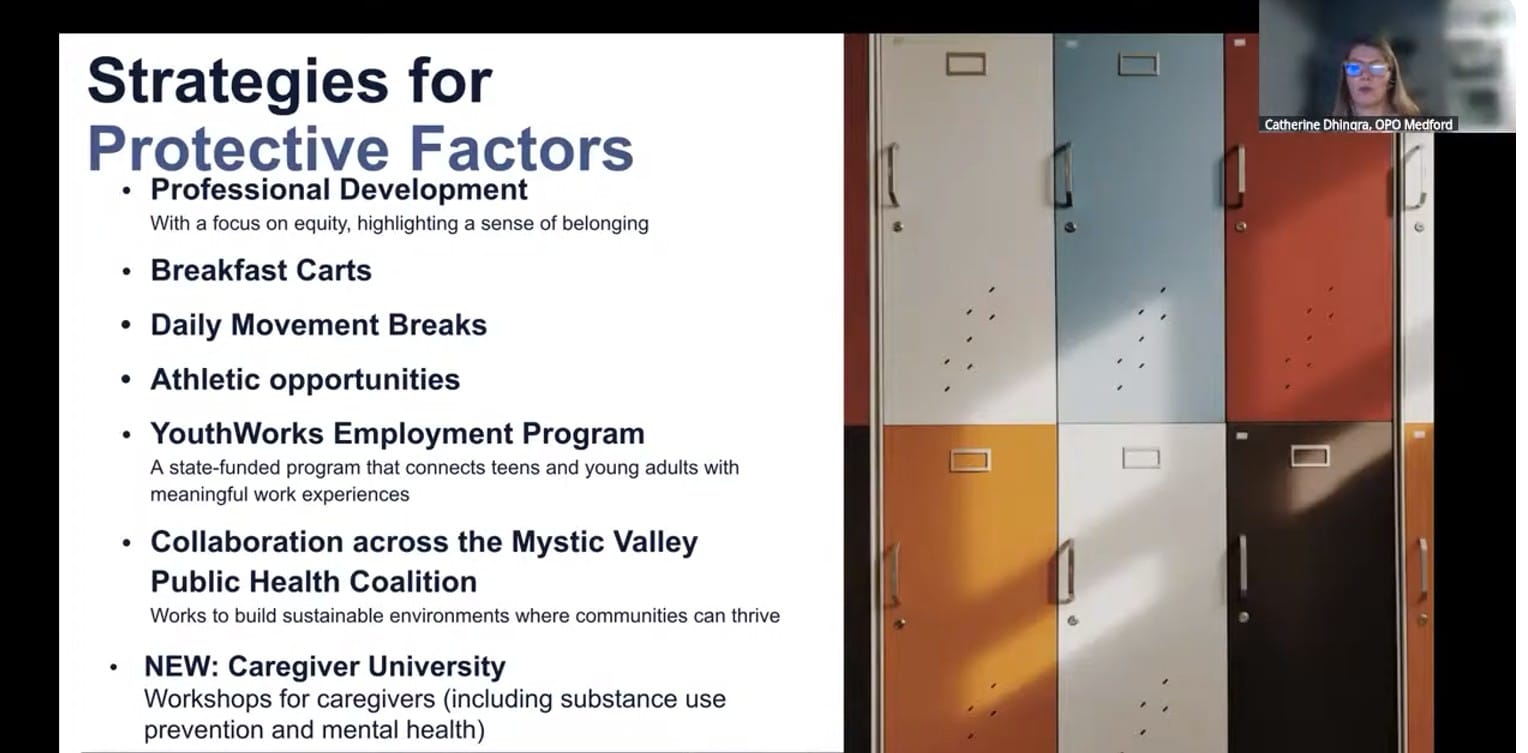
While making their presentation to the School Committee, both Dhingra and Schulman emphasized the city and School Department already provide many programs to help support students across the topics identified by the YRBS. The idea now is to add more supports in areas identified as problematic.
There are also areas in sleep, exercise and creating a sense of belonging the district plans to target.
For example, administrators saw the data surrounding students of color and LGBTQ+ students, which was often different than white peers. They are working to make changes to the school culture to foster a more diverse community.
Galusi said that has been an overarching goal of the district since she took over in January 2025.
“We are definitely working to diversify,” she said. “[In the survey] we saw that there was a lot of impact on a group of Black students. We are working to be intentional about diversifying.”
Galusi said the district is working with City Year for a second time, and there has been a request for student teachers of color for the district. She added another goal is to hire more teachers and staff of color.
“We are working on belonging,” Galusi said. “We have students who say they have adults they trust, but now we want to help them see themselves as students who belong in their classes. We want them to see themselves as writers and scientists and mathematicians.”
She said the Voke manages to foster that sense of belonging because when all students are in shop class, they are all mechanics. She said it now has to carry out across the entire district.
Professional development in the past two years has been about giving students a sense of inclusion in their classrooms and school. She said the schools received a $200,000 BARR grant last year to fund the Grade Level Engaging, Affirming and Meaningful (GLEAM) initiative over the next two years.
“There is a lot of work going on in grades 6-12,” Galusi said. “A lot of work being done.”
What’s next?
While school officials continue to explore the data and figure out what areas to shore up and what areas need more support and resources, Shulman cautions the survey is one data point.
“It’s a snapshot in time,” she said. “It’s also an initial benchmark for us. We will continue to contextualize it as we go through the data. We have a lot of mental health supports in Medford and we have a phenomenal staff and a great community that is connected.”
Dhingra, who has seen similar surveys in her work, said it’s interesting to see how the data lines up not only across the state, but across the country in terms of trends. Like, for example, how youth substance abuse is trending downwards across the country and in Medford as well.
She said the Health Department will continue to work through the data and look at strategies to implement and how to fund programs. And, she added, the city can also work with state agencies to find more resources for both the schools and residents.
Both said there’s still a lot of work to be done in disseminating the survey information and data to anyone and everyone who wants to hear about it. And, of course, in continuing the work of finding additional supports and implementing them.
When asked how Medford did overall in its first YRBS, Shulman smiles.
“We did pretty well,” she said. “Medford has a lot of supports. We have wonderful students and our numbers are better or comparable to the state averages.”


