Table of Contents
By: Crystal Yormick
A volunteer-run nonprofit is planting a mini-forest at Tufts Park to increase Medford’s tree canopy and biodiversity.
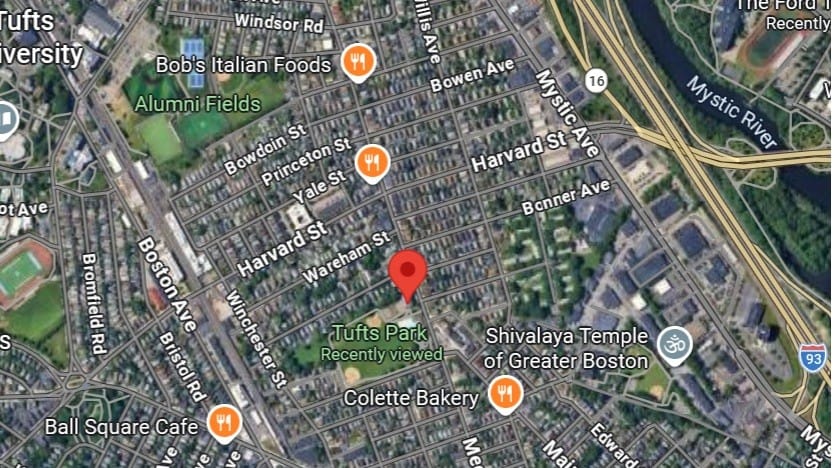
The mini-forest will cover about 1,100 square feet at Tufts Park, a popular off-leash dog park site. Work is under way, and planting will begin in September.
By increasing canopy coverage, TreesMedford aims to reduce heat, strengthen air quality, manage storm water and make the area healthier and more livable, according to the advocacy group’s website.
The nonprofit is focused specifically on heat island neighborhoods, said Jared Ingersoll, chair of the TreesMedford mini-forest subcommittee.
Heat islands are urban areas with lots of structures and little greenery. They often have higher temperatures than surrounding areas with more natural landscapes and tend to be in environmental justice areas, which are places disproportionately affected by environmental hazards, often in marginalized communities. Glenwood, South Medford, and Wellington are focus areas with heat islands listed on the organization’s website.
TreesMedford sought public input to determine where to plant the forest, Ingersoll said. The group selected Tufts Park because of its “large, open, unutilized space,” he said.
When vetting sites, TreesMedford considered whether they had invasive species nearby, proximity to water, exposure to sunlight, and trees already there, Ingersoll said.
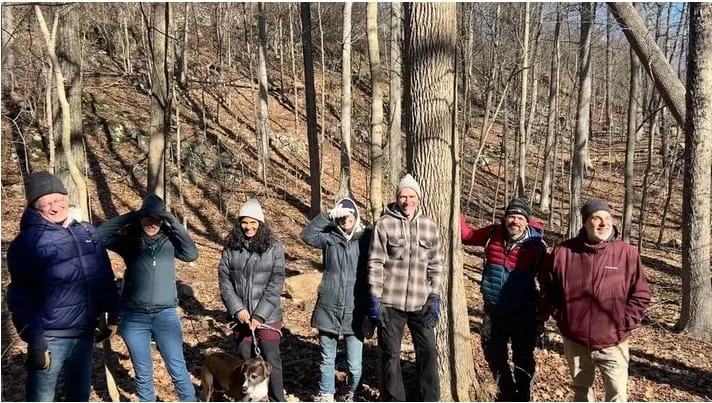
Dan Bender, a volunteer with TreesMedford and owner of Wilderscaping, a landscape designer, said one of the goals is to bring in a diverse group of trees, so the entire forest is not vulnerable to diseases that might sweep through the area.
The budget for the project is $11,000 to $12,000, Ingersoll said. TreesMedford received a $10,000 grant from the Medford Community Fund Committee to cover some of the costs.
The mini-forest follows the Miyawaki method, a dense-planting style developed with native trees and plants. This differs from typical street-tree planting because plants and trees are placed close together so they compete for light and close canopy faster, which helps limit weeds, create habitat faster, and reduce maintenance over time, according to the TreesMedford website.
“The idea is you can sort of supercharge tree growth by simulating the conditions of a really healthy forest environment,” Bender said.
In the mini-forest’s first few years, there is significant growth, Ingersoll said. By reintroducing these natural communities, certain wildlife in the city can be restored.
“The mission is to find as close to what we find in the woods down the street,” Bender said.
TreesMedford hopes to bring in about 50 volunteers to help plant the mini-forest, Ingersoll said. The organization has begun working with Curtis-Tufts High School and hopes to involve other nearby schools. He said he wants the community to think about tree coverage, but he also wants to provide a community event.
Soil prep is set to begin at the end of May. There will be two opportunities for community involvement: Site Preparation Day May 23 and Community Planting Day Sept. 19.
The forest will take around 10 years to grow, Ingersoll said, and for the first three years it will need to be regularly maintained before nature can take over.
Mayor Breanna Lungo-Koehn said if this mini-forest works, she could see the city potentially planting another one and would love to see more ways to increase tree coverage across different avenues, including mini-forests and tree plantings.
Once the canopy is established, the next step is introducing forest-floor species and flowers, Ingersoll said, and to add flower beds on the perimeter of the forest. Ingersoll said one of the project’s goals is to educate people on different ways to use their own space.
Once the forest is finished, Bender said, the park will be a space he looks forward to using and enjoying.
“We need healthy, intact forests,” Bender said “We need biodiversity. We need genetic diversity in those forests so that, as we sort of progress as a species and a society, we can preserve a little bit of what matters out there.”
This story is part of a partnership between Gotta Know Medford and the Boston University Department of Journalism.