
Table of Contents
Dr. Kim Talbot has a story to tell, and while that story is long and complicated, the final results have given the assistant superintendent for academics and instruction a reason to celebrate.
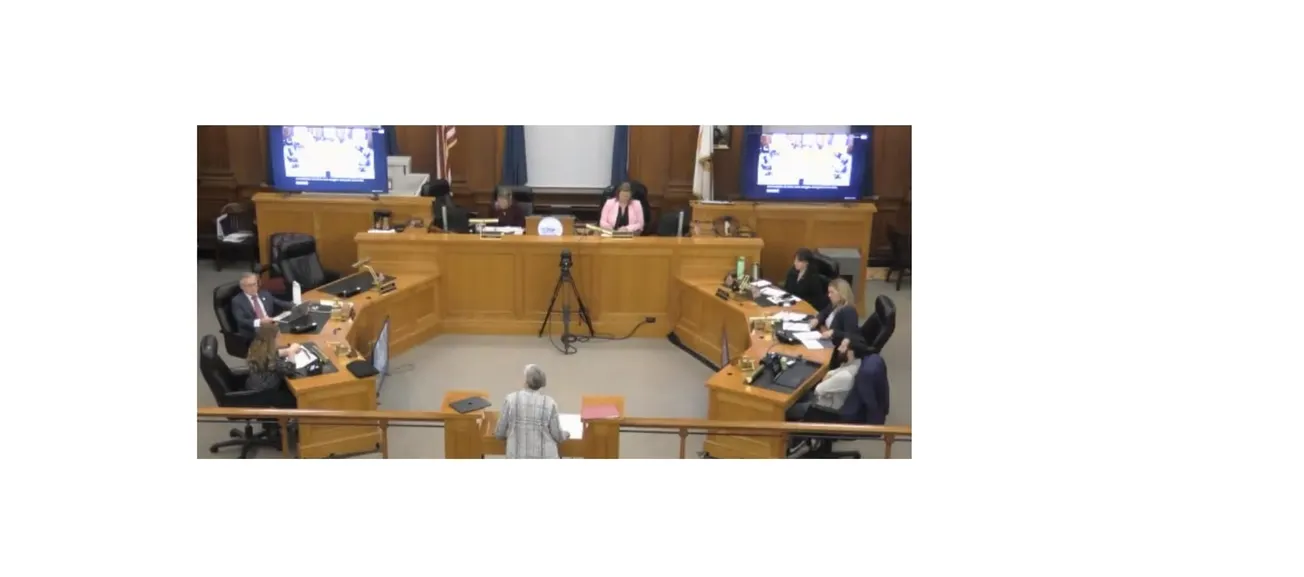
Talbot was before the Medford School Committee on Sept. 28 to give the first of three presentations on the results of the MCAS testing from earlier this spring.
Two other presentations will be given to the School Committee at upcoming meetings focusing on English language learners and specific results from the MCAS test itself.
But on Monday, Talbot was there to talk about accountability, data which comes from standards set annually by the state Department of Elementary and Secondary Education (DESE) in December.
Those standards change each year, Talbot said, and districts find out in June each year how they’re doing.
There is no way for districts to prepare for what the new academic standards will be, she added, so schools must have a plan to deal with those variables.
The state continually measures how districts stack up against themselves year-over-year to determine if they are moving towards the set goals or are falling short. Falling short means further instructional measures will be needed to move the needle in those districts overall or school-by-school.
Why it matters
Massachusetts voters in November 2024 did in fact repeal, 59% to 41%, the use of the MCAS exam as the sole indicator of students graduating from high school. But that’s it. The vote was not to do away with the MCAS.
Students across Massachusetts take the MCAS every year between March and May. Results and individual student reports are sent back to districts by late September.
While most districts and parents lament the MCAS, Talbot sees it as an important indicator of where Medford students are in their education.
Take, for example, the accountability report.
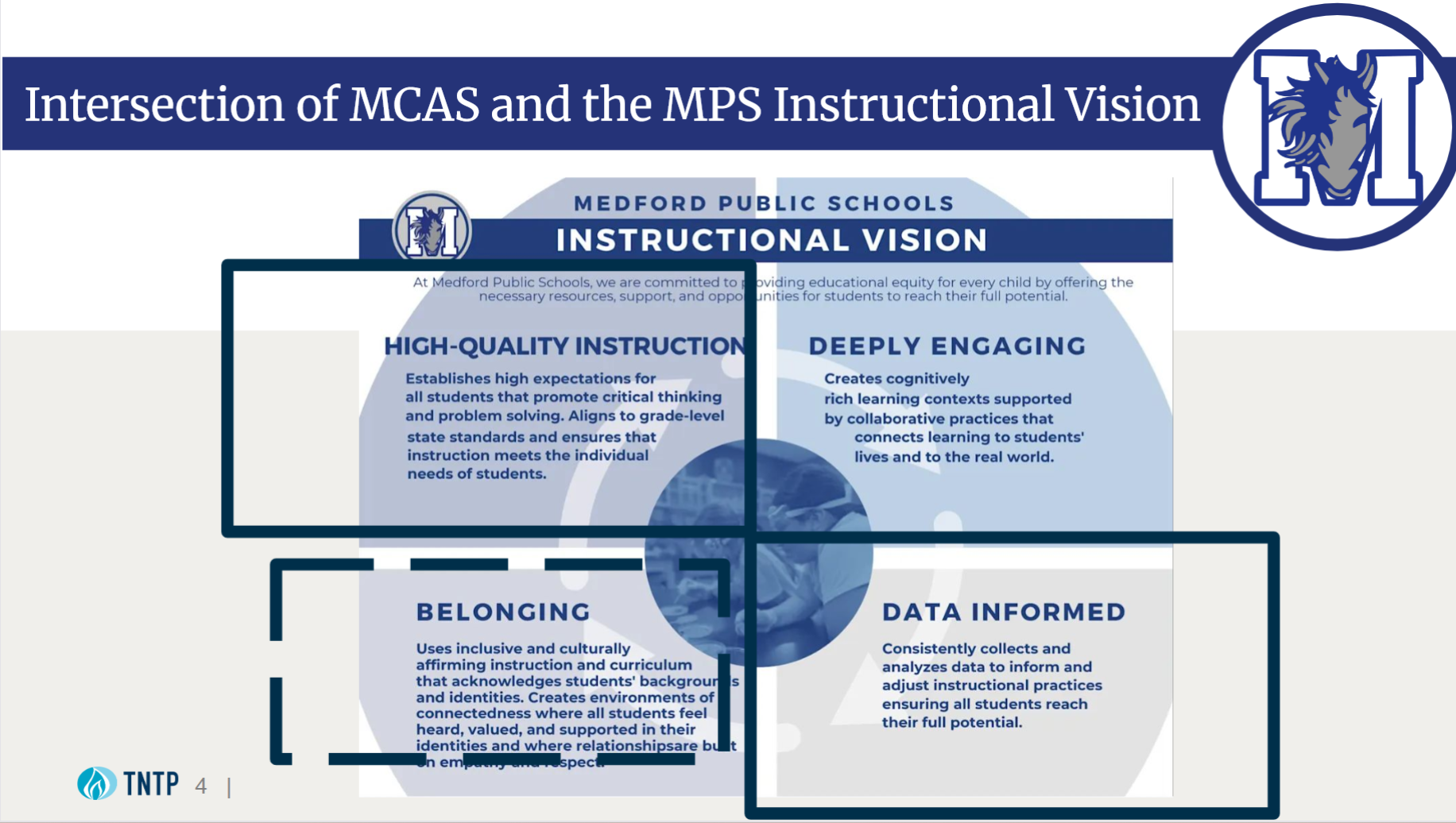
Talbot said the MCAS intersects with Medford’s instructional vision, which she identified as:
- High-quality instruction
- Creating a sense of belonging that “acknowledges students’ backgrounds and identities”
- Being deeply engaging by “creating cognitively rich learning contexts by collaborative practices that connects to students’ lives and to the real world”
- Remaining informed through data the district will consistently collect and analyze to adjust instructional practices
The most important thing to remember, Talbot said, is that students are at the center of academic life. That’s the target audience around which every decision made by the district revolves.
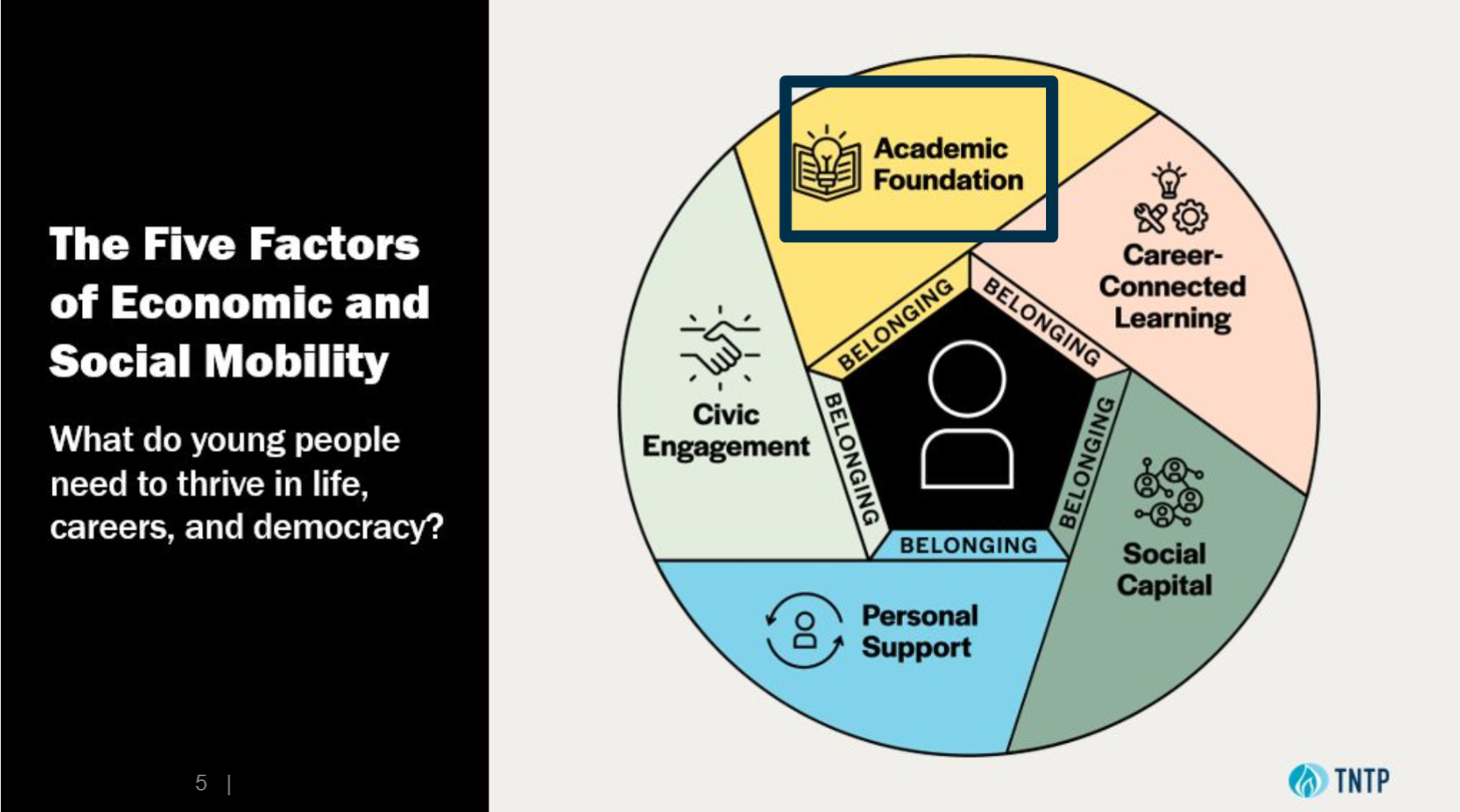
She said there are five factors students need in order to thrive in life, careers, and democracy: an academic foundation (the most important factor), personal support, civic engagement, career-connected learning, and social capital.
“Giving kids an academic foundation is so important in the work of our schools because it supports all of these factors in order to help students thrive in the future,” Talbot said.
That foundation, she added, contributes largely to the future economic and social mobility of students as they mature into adulthood.
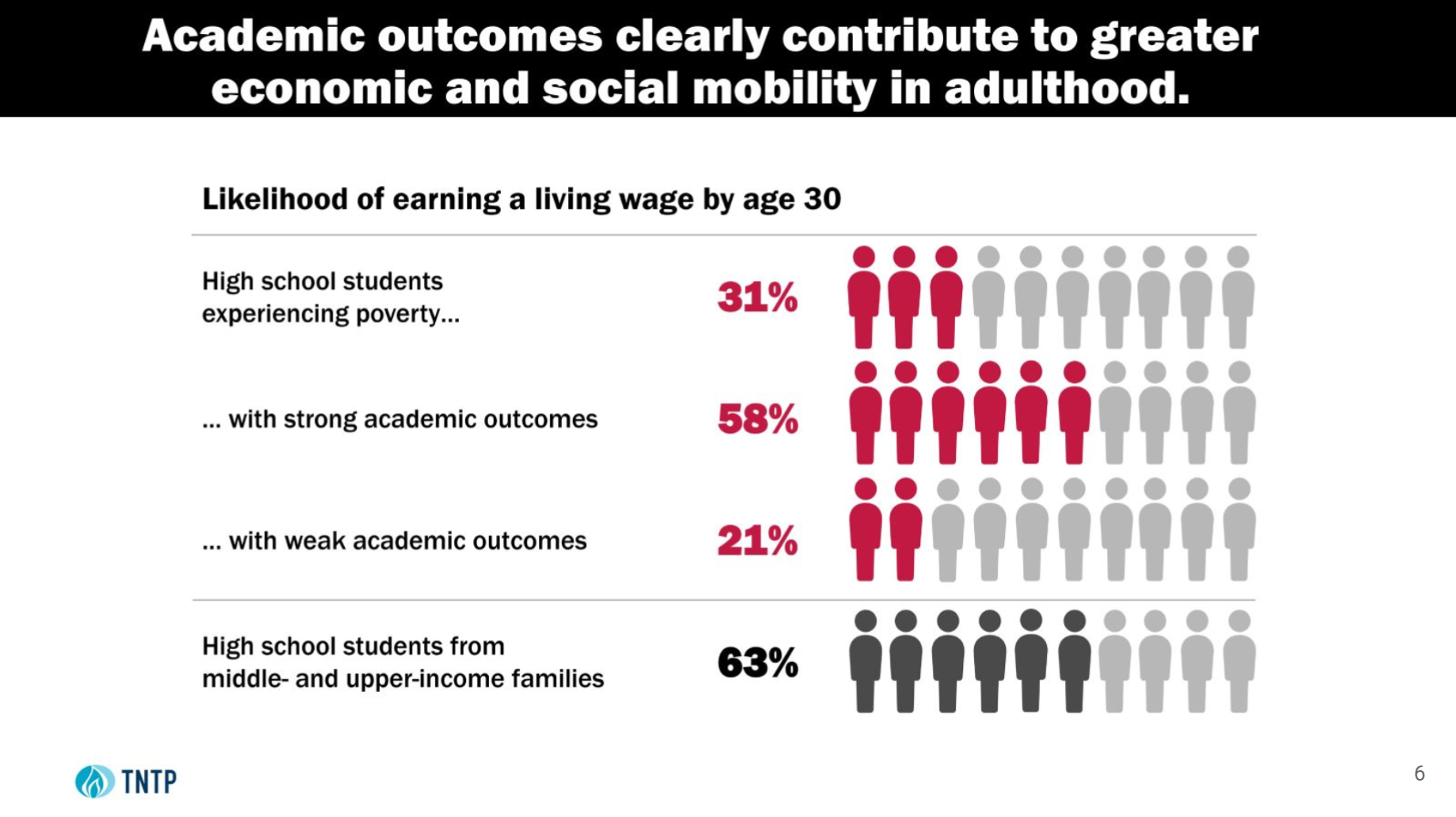
Drawing on data from a study conducted by non-profit TNTP, Talbot said 63% of students from middle- and upper-income families are likely to earn a living wage by age 30, as opposed to only 31% of lower-income students.
With the right academic support and foundation, Talbot said, those numbers rise to 58% for those same lower-income students, as opposed to dropping to 21% without that foundation.
“That’s the purpose of education,” she said, of the stats. “That’s why all of this matters so much to us.”
Talbot said that during the 2025-26 school year, 29% of the 3,778 students enrolled in the district came from lower-income families. Unlike other demographics, such as special education students or English language learners, lower-income students are in every classroom at every grade level.
So what does all this mean? And why does it matter?
In her presentation, Talbot answered those questions with the following:
“The purpose of the accountability system is to:
- provide clear, actionable information to families, community members, and the public about district and school performance, and
- help the state to direct resources and assistance.”
She said all of it matters because the state is working hard to close that educational gap.
Talbot continued by giving a quick overview of the key features of the accountability system. Those include achievement, high school completion, student growth and English language proficiency and additional factors like absenteeism and percentage of students in grades 11 and 12 completing advanced schoolwork.
“It matters so much that academic achievement is actually three of the five indicators in the state accountability system,” she said. “It’s not just about what the students do. The state works hard to set targets on grade level and throughout the population.”
Medford’s accountability numbers
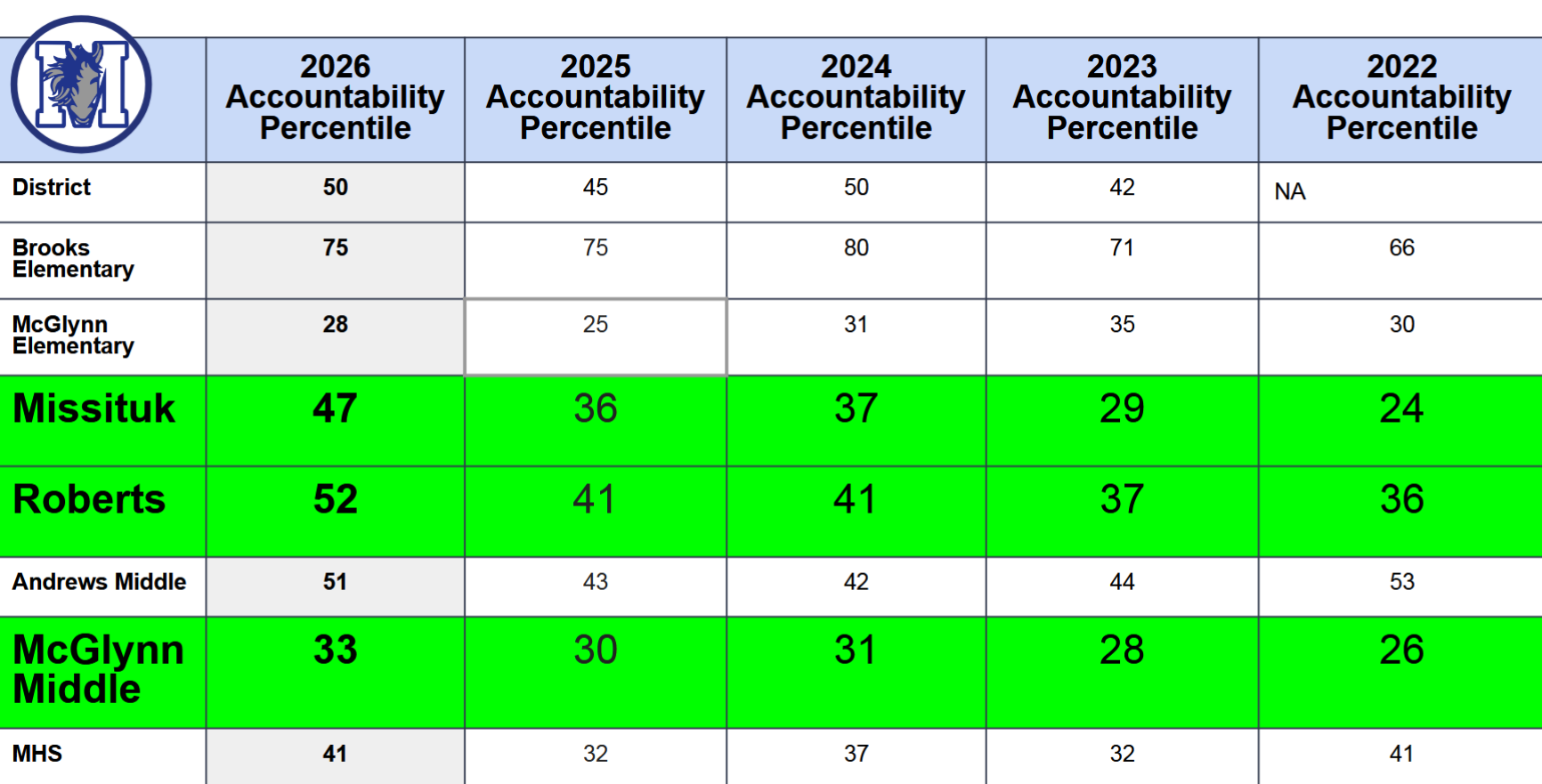
With all the data available, Talbot said, Medford had a lot to celebrate this year. Overall, the district has seen “substantial progress towards targets – not requiring assistance or intervention,” according to the state categories.
That means seven of the eight schools in the city have seen substantial progress from last year, while one stayed the same. And, both the Missituk and Roberts elementary schools have increased their rates by at least 10 percentage points.
“That’s a lot of people working together for students towards a single goal,” Talbot said. “That is absolutely something to celebrate!”
Superintendent Suzanne Galusi reminded the School Committee and residents that while it is a celebratory moment for Medford, there’s still more to do. No one, she added, is sitting on their laurels.
“We’re always going to have work to do,” she said. “That is clear and that is evident.”
But, Galusi said, what the administrative team and staffers are really working on "is the consistency and the coherence and the priorities of why we’re here, which is the students. I think this data speaks to all of us that we’re rowing in the same direction.”
Talbot’s dream
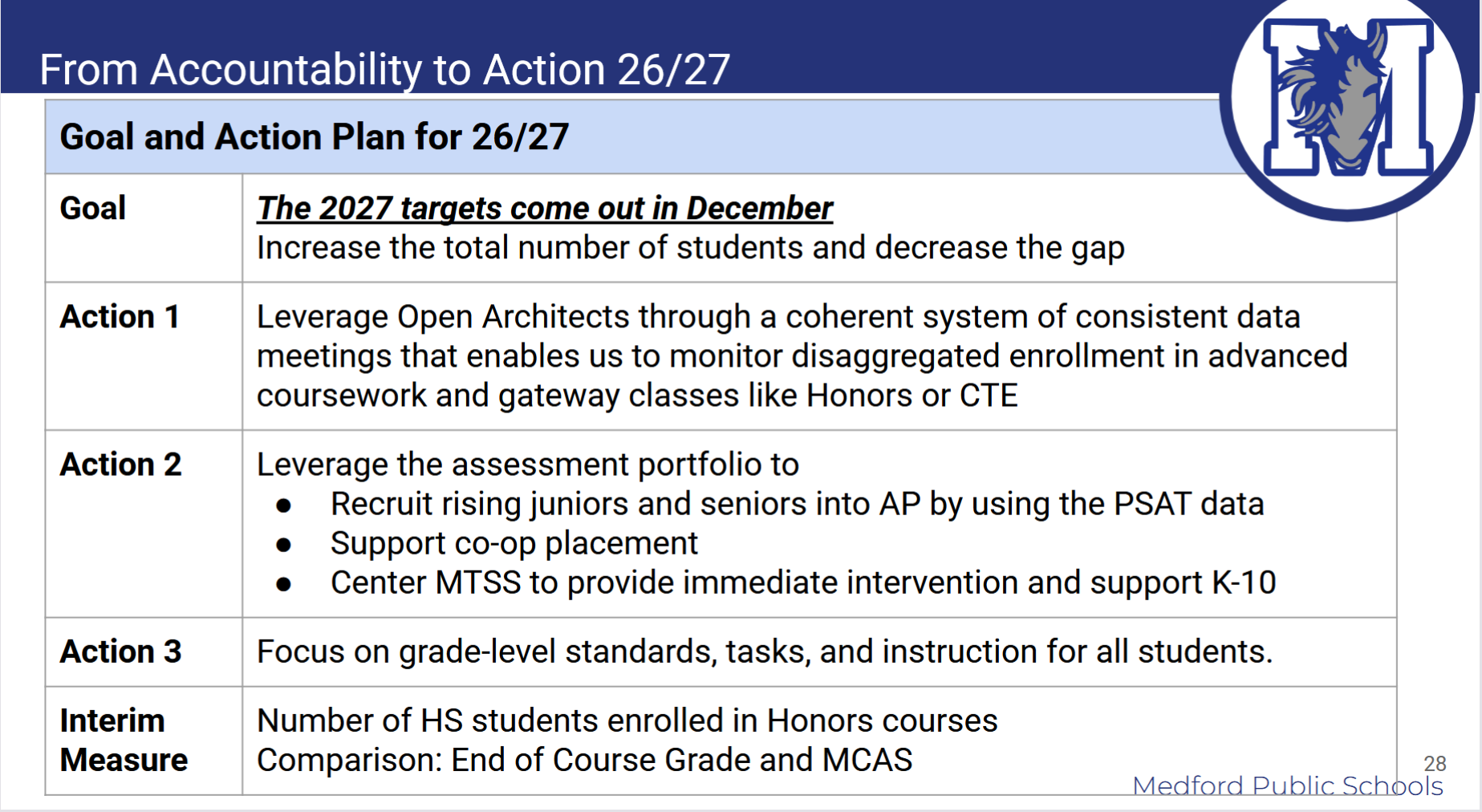
Last September, Talbot decided to find a piece of the accountability criteria on which to work. She decided to focus on the number of students completing advanced schoolwork as juniors and seniors.
Just to be clear, she added, this is all ground work that starts in kindergarten and continues throughout a student’s academic career.
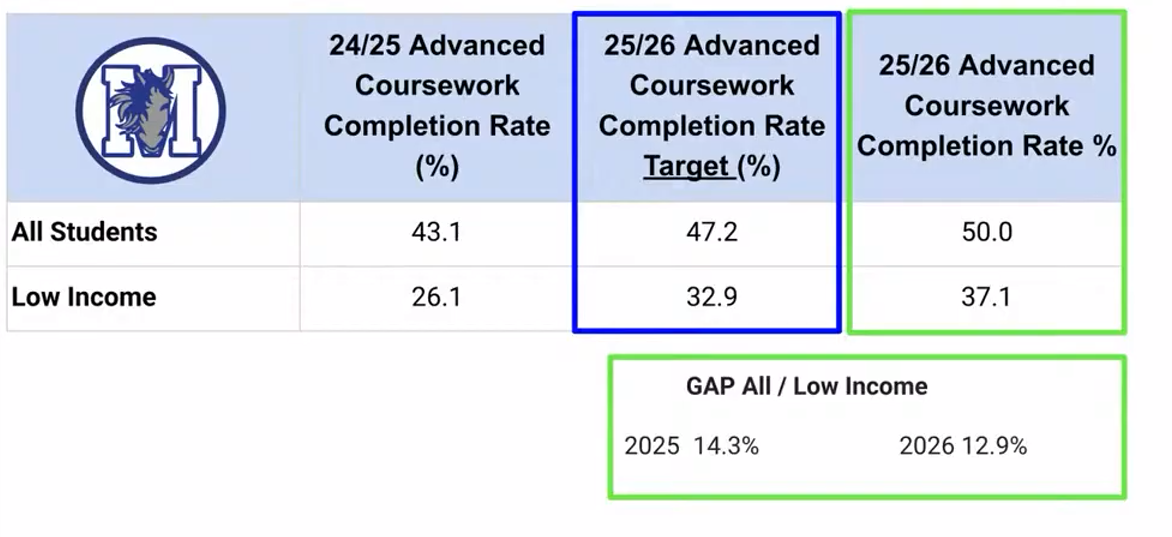
So, Talbot started digging for what target numbers were set by the state for this criteria during the 2024-25 school year, and she finally found them: 42.3% for all students and 25.5% for low-income students.
Those targets were up for 2025-26: 45.7% for all students and 31.7% for lower-income students.
The question was how to meet those targets and then exceed them. Talbot set a goal to meet the overall student goal for 2025-26 of 47.2 % and decrease the gap for lower-income students from 16.8% to at least 14%.
Talbot and her team verified the state data for Medford, created a new system to track the enrollment in advanced classes, and focused on grade-level standards across the district.
The end result? Medford exceeded the advanced coursework completion target for 2025-26 at 50% and the set-target for lower-income students of 32.9 went up to 37.1%.
That means the gap from 2025 to 2026 for lower-income students dropped from 14.3% to 12.9%.
Talbot admitted that while it’s a small victory, it’s an important victory.
“It reminds us how powerful it is to be an educator and to make differences for kids so that they can achieve their full economic and special potential,” she said.
School Committee reactions
Admittedly, Paul Russeau is not a fan of standardized testing. But on Sept. 28, the long-time School Committee member said he was most impressed with Talbot’s report on how Medford is using the data from MCAS to create an educational vision for its students.
“It’s incredible,” he said.
Vice Chair Jenny Graham said this type of detailed report is something the committee has been “begging for.”
“I appreciate the push towards helping students see what is possible for them, because I think there are students in our system who get lost in the shuffle all the time, so the active push we are giving to students to say, ‘You can do this. We see that you can do it,’ is hugely important,” Graham said. “It’s the kind of thing that shifts the narrative about what the district does and doesn’t do in the community.”
Graham said a recent meeting where a resident said “Medford Public Schools stink” made her take note, especially since the district has made great strides.
She cited the example that Medford High School has jumped 20 points upward in testing statewide.
“We’re on the move,” Graham said.
She added she would further like the district to investigate offering students ways to pay for the advanced placement exams. Many students finish the coursework, she said, but are unable to sit for the test due to financial constraints.
“It’s unfair for someone to do all that work and not reap the benefits,” Graham said.
Graham said scoring high on the AP exams allow students to bypass taking expensive college courses and earn the credit.
Erika Reinfeld said it’s amazing to see the evidence of making a slight change by using the data available to the district. She asked where parents or residents can see the other data.
Talbot said MCAS data is available in the strategic plan.
“I wanted to put MCAS data in its place, which is a check for us in grade-level standard acquisition so kids are ready to be in the advanced coursework,” she said. “I was hoping by picking that one, I could pick up all the academic pieces.”