Table of Contents
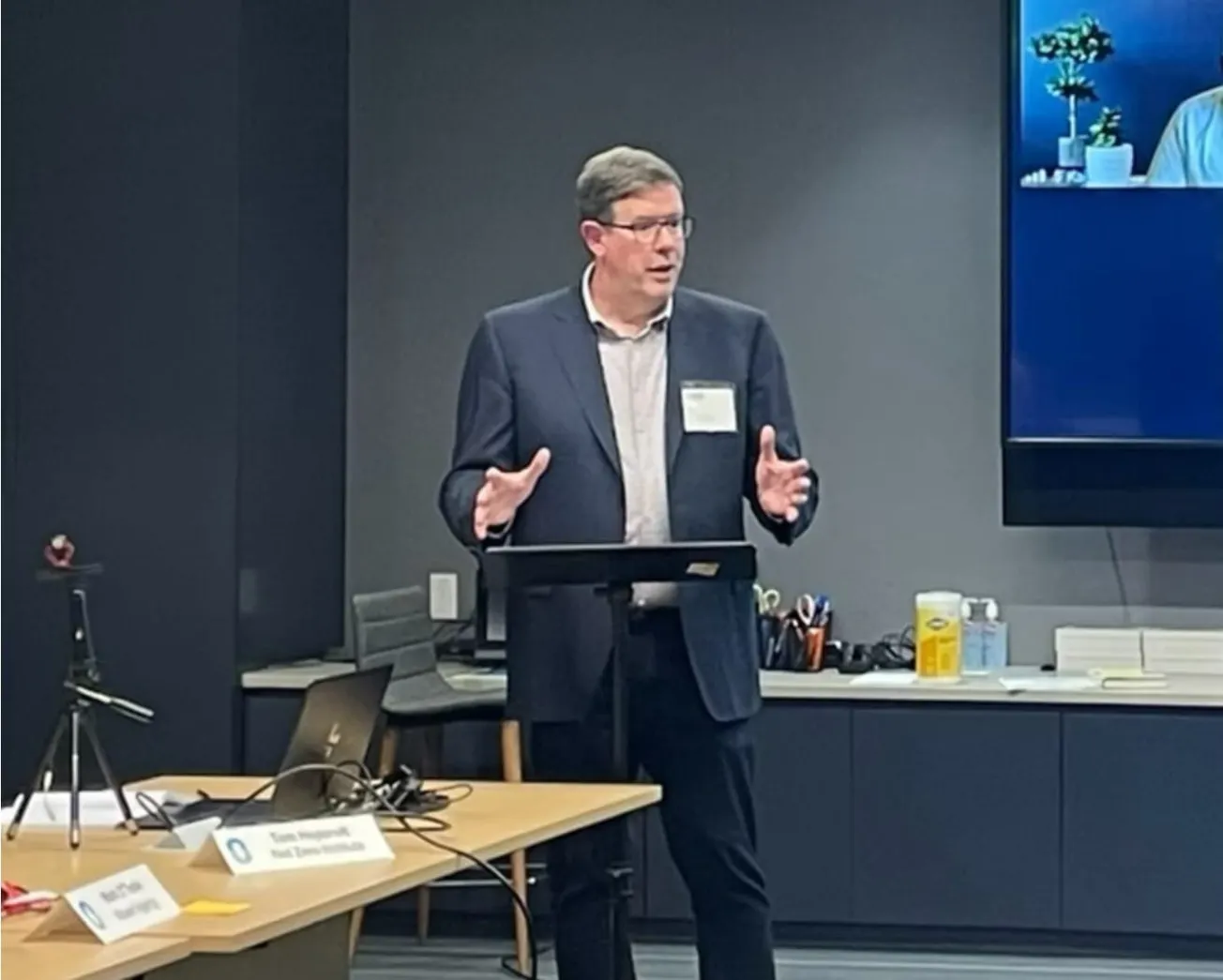
Tom Hopcroft has ended his campaign for the Second Middlesex state Senate seat after eight months, saying he did not have the money or the campaign organization to stay competitive and that he could do more for his priorities by stepping aside before the Sept. 1 Democratic primary.
His name will still appear on the primary ballot.
In a letter to supporters, Hopcroft said it is too late to withdraw and he will not campaign actively for the remaining five weeks.
Hopcroft, a Winchester School Committee member and Town Meeting member from Precinct 7, entered the race in early January to succeed state Sen. Patricia Jehlen, who is retiring.
Four candidates are still campaigning: Cambridge Vice Mayor Burhan Azeem, Rep. Christine Barber, Somerville City Councilor Matt McLaughlin and Rep. Erika Uyterhoeven.
“The race became more about process than about ideas,” Hopcroft said in an interview. “The playing field is tilted toward the insiders, and the advantages were compounding.”
Hopcroft said two opponents entered the contest with more than $100,000 already banked, while he began with roughly $2,200 carried over from his School Committee campaign.
By his account, Barber entered in January with about $100,000 on hand and Uyterhoeven entered in April with a comparable figure, although Hopcroft said he was not certain of Uyterhoeven’s starting balance and believed she had raised much of it in the quarter before she declared.
“My campaign was a lean startup learning as we built our organization while our competition had deep resources and experienced organizations from multiple prior campaigns,” he wrote to supporters.
Six priorities, and a request
Rather than finish a race he no longer believed he could win, Hopcroft said he will meet over the coming weeks with each remaining candidate to discuss a six-part agenda: climate and energy, technology and innovation, health and drug discovery, education and workforce, housing and transportation and responsive and transparent government.
He said he will ask each candidate to publicly support that agenda and will make their positions available so voters can see where they stand. He also said he intends to carry the same message beyond the 2nd Middlesex District.
“My opportunity to move the issues that I thought were important forward was greater if I stepped out before the election,” he said.
Hopcroft, who led the Massachusetts Technology Leadership Council and later founded the Net Zero Institute, said the campaign's forums focused on immediate concerns rather than where the state will be in five or 10 years. He said he does not believe the scale of federal research funding cuts has registered on Beacon Hill.
“I have a kid who is going to hopefully go to college and be coming to the workforce in five years, and another one in 10 years,” he said. “No one’s looking five or 10 years out. They’re all just looking at the symptoms of the problems and not the underlying causes.”
He said roughly a third of jobs in the state rest on the innovation economy, and argued that concentrating research funding in Massachusetts produces effects that ripple into construction, restaurants and professional services.
He cited a line he attributed to former Gov. Deval Patrick, who appointed him to the state Board of Higher Education in 2014: if the state were Texas, it would invest in energy, and in the Midwest, agriculture, but in Massachusetts the investment is in innovation, people and ideas.
Hopcroft, who said one of his two children has a rare disease, said advances in artificial intelligence and drug discovery could make treatments viable for conditions whose patient populations have been too small to attract investment.
He also said the format of the campaign’s public events shaped what could be discussed, and that he spent the spring answering questions set by the groups hosting them.
“I was always on someone else’s turf,” he said, calling for a debate commission to run neutral forums.
What he learned
Asked what the campaign taught him about competing for office, Hopcroft described a set of advantages he said accumulate long before a race begins: established organizations, positions already drafted from prior campaigns, longstanding relationships with endorsing groups and paid legislative staff who volunteer on nights and weekends.
He pointed to social media as one measure of the difference, saying he had between 100 and 200 followers on relatively new accounts while a leading rival reached nearly 15,000 people with each post.
Hopcroft also described how time in office compounds fundraising. About 60% of elected officials in Massachusetts run unopposed, he said, and a sitting legislator can accept the annual maximum from the same donors each year and carry the balance forward.
Some endorsements, he said, come with money or with volunteers to knock on doors.
Hopcroft said having a senator who lives in town matters more than voters may realize, and he told a story against himself to explain why. For roughly his first decade in Winchester, he said, he assumed state Sen. Jason Lewis was his senator because Lewis was the officeholder he saw at Town Meeting and at parades. He later learned Jehlen represented his side of town.
“Even though I don’t vote for Jason, he represents Winchester,” Hopcroft said. “He lives here. He knows the issues.”
The math of the district, he said, is difficult for Winchester. He estimated Somerville at 80,000 residents, Medford at 60,000 and North Cambridge at 20,000, against the roughly 10,000 Winchester residents inside the district.
Winchester, he said, is also the most unlike the rest of the district — a town rather than a city, with the highest homeownership and home values — and, in his view, the least likely to draw a senator’s time.
Still, he said his exit changes little on that front, because he no longer saw a path to winning as the Winchester candidate.
Hopcroft told supporters the campaign is changing lanes rather than ending.
“We’re stepping out of this race, but we’re continuing to push the mission forward,” he said.
Will Dowd is a Massachusetts journalist who covers municipal government and community life for Winchester News and is a frequent contributor to Gotta Know Medford. He is also the founder and editor of The Marblehead Independent, a reader-funded digital newsroom.