

Medford's urban forest needs some TLC and some funding, according to a new report
A new report recommends Medford protect its tree canopy and work toward doubling the number of trees planted each year.

By Crystal Yormick | Correspondent
Medford should focus on growing, protecting and maintaining trees as key strategies for creating a “healthy, resilient and equitable urban forest,” according to a new report.
The Urban Forest Management Plan recommends strengthening tree ordinances and standards, maximizing tree canopy in limited spaces, and increasing staffing, tree diversity, and annual tree plantings. Doing so would help the city address issues of canopy loss and a lack of canopy coverage.
The City Council unanimously passed a motion on March 10 urging the city to implement the plan and set a goal of having canopy coverage of 35% in residential areas within the next 10 years. It requests that the city allocate resources in upcoming budgets to carry out these goals.
Medford’s tree canopy — the layer of leaves and branches visible from above — declined citywide by about 1.2% from 2015 to 2021, according to the report. While any loss is unwanted, 1.2% is “actually not bad” when compared to other communities that have lost canopy faster, said Matthew Soule, a team leader at Weston & Sampson, the engineering and environmental consulting firm hired to do the report.
The plan, which was funded by the state, recommends that efforts to create this urban forest should be prioritized in environmental justice areas, which are places disproportionately affected by environmental hazards, often in marginalized communities. Vacant sites and sites with dead trees should be inspected for planting, and the city should look into replacing species in poor condition.
The report recommends that by 2030 the city double the number of trees planted every year. Soule, who explained the report’s findings during a March 30 presentation at the Medford Public Library, said doubling the current number of trees planted annually from 200 to 400 would reverse projected tree losses over time.
“If we stuck with 200 trees a year, it becomes much harder to get that to make up those losses,” Soule said.
The presentation also called for the city to increase its forestry budget by $400,000 a year in order to reach these 2030 goals and to add three positions–an additional forester and two laborers. These increases would allow the forestry department to plant and manage more trees, Soule said.
Amanda Bowen, who is co-chair of TreesMedford, a volunteer nonprofit that supports tree planting and stewardship, said the goals to increase the budget and staff are realistic but might require grant funding. Some cities charge developers for removing trees and pointed towards that as another way to build funding, she said.
Residents at the March 30 presentation expressed concerns and excitement at the report’s findings. Concerns included the survival likeliness of trees, why more money is not spent on watering, pruning and maintaining the trees once they are planted, and the city’s role in trees on private land. Medford Public Works Commissioner Tim McGivern said the city has no obligation to spend public money on private resources but tries to help out where it can.
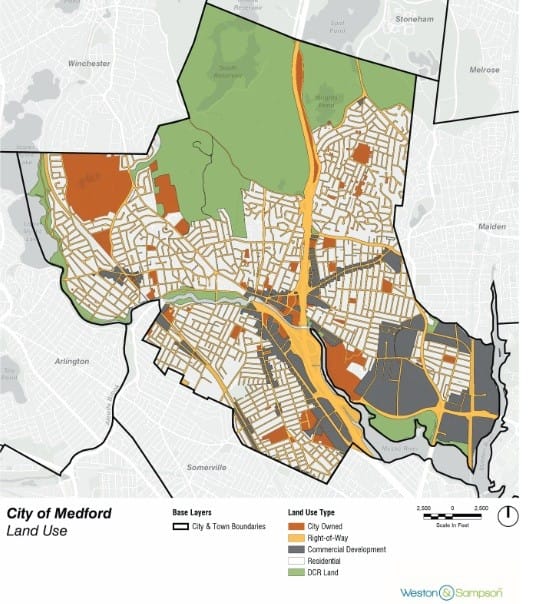
McGivern said the inventory of public trees is the most powerful finding from the report. Medford’s private roads are absent from the inventory, he said, but the city can still plant on private property if it has the permission to do so.
Residents can request that the city plant trees in their neighborhood, said Medford Tree Warden Aggie Tuden. If multiple residents on a street request trees, they’re more likely to get them, Tuden said.
There are about 10,000 public trees in Medford. About 10% of them are in poor condition, and 1% are dead.
There are challenges to planting trees in Medford, Soule said. Some sidewalks are too small, and there is limited space in some areas. To address this, he said trees can be planted more densely and between trees that are expected to die soon.
City Councilor Justin Tseng said there are ways to find funding to plant more trees, such as grants. Plans often die in filing cabinets, he said, and he wants to make sure that that doesn’t happen here.
“You need a spark like this meeting to galvanize people together,” Tseng said.
This story is part of a partnership between Gotta Know Medford and the Boston University Department of Journalism.
Gotta Know Medford is a small, independent newsroom dedicated to keeping you up to date on what's happening in the city and to covering the issues that are important to you, your family, and your community. We couldn't do this without your support. Join us.