
Table of Contents
After countless meetings, community forums and discussions about a new high school, Medford residents finally know what the project’s scope is. But not it’s final price tag.
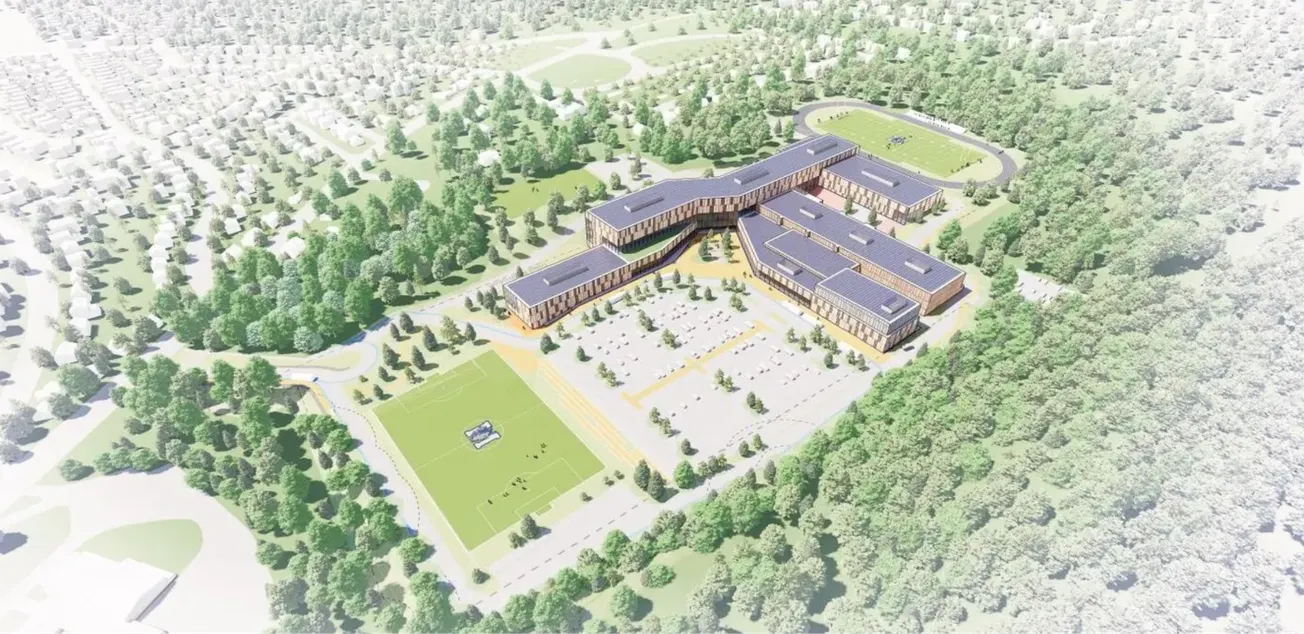
The Medford Comprehensive High School Building Committee (SBC) on Oct. 6 finalized the project’s scope: a building with 567,877 gross square feet and an estimated cost of $699,862,410.
The SBC also approved a motion to enter negotiations with Suffolk Construction to join the project as the construction manager at-risk, making the company responsible for all construction aspects of the project, including planning, building, scheduling, and budgeting.
Mayor Breanna Lungo-Koehn sits on the SBC and has been vocal about bringing the price down from an early estimated $850 million project to a more manageable number the city and its residents can afford.
After all, the Massachusetts School Building Authority (MSBA) only guarantees Medford will receive a 53% reimbursement of the eligible costs on the project. That would mean the state would reimburse an estimated $226 million while the city would pay an estimated $474 million.
The mayor recently sat down to talk about the project and whether she’s satisfied with the new estimate.
“I, of course, wanted to reduce it even more,” Lungo-Koehn said. “I really want the community to support a vote on June 8, 2027, and my main hope is building a new high school for our students.
“I’m happy it wasn’t $850 million and that it’s down to $700 million, but I also have a hope that the designers are looking for even more efficiencies,” she said. “The likelihood this will pass will be based on making it a reasonable sized school while meeting the educational plan.”
Lungo-Koehn said it’s a fine line at the moment on how residents will vote on a debt exclusion for the project.
“What I keep hearing is that there are many people who fully support the project whatever the price tag is,” she said. “But I’m also hearing from other people when I’m out and about that times are tough, prices are high. [A few] weeks ago, I was talking to a family with children who were concerned over their heat because the oil companies were saying it’s going to be a tough winter.”
The mayor said the balancing act has her worried.
“On one end, I feel like we will be able to get the work done with $700 million,” she said. “But I hope we’ll find more efficiencies.”
What are those efficiencies? The mayor said as designers work their way through the space, they might find they need to reduce a room size from 950 square feet to 900 or even 850, and those reductions mean saving additional money.
Lungo-Koehn said that during the meetings in which every square foot was scrutinized by the SBC, she pushed for even more cuts.
So what’s the sweet spot for her?
“I don’t know if it’s a number,” the mayor said. “I’m pleased we’ve reduced it by $150 million, but I’d like to see it drop even more.”
SBC Chair Jenny Graham is also pleased to see the number come down. She credited the hard work done by the 25-member SBC for meeting climate and educational goals while keeping the unique features of MHS intact.
“I’m happy with that work,” Graham said. “I’m happy we took the time to go through all those spaces and to make sure that we are not overbuilding.”
Also, from July to Oct. 6, the body focused on creating a space summary where there was dedicated time spent on every nook and cranny of the new building. Graham said the deep dives of every single square foot are on video that can be seen on YouTube. Residents can also find links on the project’s website.
She said residents who did attend SBC meetings and tracked the project have asked some really good questions. And, she added, questions that were presented to various SBC members were also answered.
“Until the project completely unfolded, there were all sorts of bits and parts,” Graham said. “None of these decisions were made in a vacuum. They were made with the most complete set of information we had.”
Yes, Graham said, there were plenty of times when designs were presented that would have been a wish-list item. For example, having underground parking would have allowed for two extra fields above the structure. Or, how about a swim basin for people learning to swim at the pool? Graham said those decisions would have added millions to the project. That’s why the SBC cut them.
So is she satisfied with the $700 million number?
“I can say with confidence that the things we want to preserve and that residents want to preserve, we’ve done,” Graham said. “That’s a big deal and it’s a big win.”
The presentation
Earlier this spring, Lungo-Koehn, along with the city assessor, made a presentation before the SBC and community members that left her feeling upset.
She said it came to her attention several residents were using the Signal app to make sure the city’s presentation was disrupted.
“It was a coordinated effort to paint me as a disrespectful and offensive presentation-giver,” she said. “It changed the tone of the meeting, that I was against children.”
Gotta Know Medford has independently verified that some residents were contacted via a Signal chat and asked to negatively weigh in on the mayor’s presentation.
“You know, I’ve lost sleep about the final price tag [of this project] because I want to see a new high school built,” she said. “A higher price tag means it’s more likely to fail. I felt it was my duty to present the facts as they were at the time.”
She said that during the SBC meetings, there didn’t seem to be a lot of people attending. However, she said she has run into many people on the street who give her the same message over and over: “It’s a really expensive process. I just don’t know.”
Graham said the mayor’s presentation this spring may have been a bit premature.
“Based on what the project team said, it might have been a bit early for a conversation on the cost to taxpayers,” she said. “I viewed it as a worst-case scenario.”
Graham said she wasn’t aware of any campaign against the mayor, but she did say the mantra being spread around, which is “the mayor doesn’t like kids," is ridiculous.
“The mayor is very supportive of this process,” she said. “I do not think the mayor hates kids. She has been more critical of the project, but then I expect that’s because she has a front-row seat on the committee. She’s rightfully worried about the cost, and I think we all are.”
Graham said the mayor’s team has been working to analyze the numbers on the city side when it comes to revenue, new growth, and the city’s ability to pay the project price tag. They will continue to do so until the MSBA contract is signed next year.
“This is something that has to be done,” Graham said. “She has to be responsible to the residents.”

What’s next?
There’s still more work to be done before the city places the vote in the hands of its residents.
Graham said in February, Medford has to sign an agreement with the MSBA and that’s when the city will find out what the school project will really cost. She said right now, $700 million is an estimated cost. That’s the number everyone has agreed to stick to, but there are construction costs to factor in. She said that’s why Suffolk Construction is on board so early.
“No one wants surprises,” Graham said. “This is a big, complex project and we want them to be a part of the next round of estimates.”
She said the idea that school projects can run over budget is a fallacy. She said when it comes to school construction, it’s strictly stick-to-the-budget.
“There’s a max ceiling that the project can cost,” she said. “That’s good protection for the city.”
Meanwhile, the design team is doing the nitty-gritty of placing walls and floors and whatever else needs to go into a new high school. Residents will soon be able to visualize what a new building will look like.
“That’s the next evolution of the design,” Graham said. “We will begin to see what an exterior will look like, and I’m sure we’ll see more evolved models.”
If the debt exclusion passes, the construction documents will be built out, vendors and trade unions will be hired, and it’s full speed ahead. A project could break ground sometime by the summer of 2028, with construction estimated to end by 2034.
“There’s no shortage of commitment for this project to happen,” Graham said.
Will a debt exclusion pass?
On Jan. 1, 2027, the city of Medford will switch to a brand new charter, and there will be a huge political change. The mayor’s term will go from two to four years; the City Council will move to ward representation and add four new members; and the School Committee will represent districts instead of being at-large.
Will all those changes affect the high school project? That’s something on Mayor Lungo-Koehn's mind.
And, she said, she’s pretty sure the City Council is gearing up to run a candidate against her for mayor next November.
“It’s been pretty clear since November 2025, and it’s grown exponentially,” the mayor said. “I’ve asked everyone to please stick to the issues and leave the high school out of it. It’s been tough to be on the receiving end of all that hatred, but that’s my hope, that we keep politics out of it, because our children deserve a new high school.”
Graham agreed.
“I believe everyone will coalesce around this project,” she said. “At the end of the day, we have a chance to do this with the support of the state. To not coalesce, would be crazy.
“We encourage people to be individuals, but the truth is that we only get things done when we work together,” Graham said. “For me, I hope our elected officials will all decide what communities across the state are doing when something like this is presented, and that’s that our differences don’t mean we can’t agree about this. We have to support this, it’s that simple. There’s no conspiracy. It shouldn’t be who did what to whom. We want a new high school and the money is coming from the state. The answer to that should be yes.”
The city on Nov. 12 released a statement from the mayor’s office, City Council, School Committee, and SBC in support of the new high school project. The release offers reasons for the new building, cost projections, and how residents can engage with the project. A list of meetings is also available on the project website.
So, does the mayor think a debt exclusion will pass?
“Half the time I think it will pass and then half an hour later, I will think it won’t pass,” she said. “People are struggling out there and not everyone can afford it.”
But as the chair of the School Committee, Lungo-Koehn said, she hears presentations by administrators that the most vulnerable of Medford’s students need a new space that meets today’s educational needs.
“I know there will be people who just can’t afford it,” she said. “And I know there will be people who are pushing for it. I just don’t know.”
Graham, however, is confident that if the city makes the case to the community, the debt exclusion will pass.
“When we find out the reimbursement numbers, I think the people who are concerned will feel good about the work that we did,” she said. “I just don’t see our community — a community that values education — wouldn’t agree."
“I hope our community sees how much work has gone into this project and feels good that we have taken this project so seriously,” Graham said. “But no one has done it alone. We have done our best to be good stewards of what our kids need and what our city needs.”