
Table of Contents
Though you won’t find it listed in any New England travel round-up as a must-see destination, I’ve discovered that Medford, while not on a par with Portland or Newport or Stockbridge, has its own distinctive charms, which are best revealed if you’re on foot.
In fact, my last couple of visits home – ostensibly undertaken to reconnect with family and friends – were in effect two very enjoyable walking holidays. Without ever abandoning the comfort of my boyhood home, I found myself transformed into the type of traveler who sets out on an Alpine trek in Italy or ambles around Snowdonia in Wales or indeed tackles any portion of the Appalachian Trail.
OK, that might be a slight exaggeration. But assuming you live nearby, the idea of exploring your hometown and environs as a getaway option does make a lot of sense these days, given the escalating price of gas, the general unpleasantness of air travel, and the crazy and potentially lethal weather.
So as a primer of sorts, here’s a sample route that illustrates how an extended walk around Medford can yield countless points of interest, especially if you were brought up there.
First off, to paraphrase a famous fashion model, I don’t get out of bed for a walk much shorter than 10k. This is the recommended distance you should cover in a recreational walk, roughly six miles spread across two plus hours of steady perambulation.
My go-to route, which I modify each time I visit, has a fair measure of personal history mixed in. I start out from my sister’s house – which is a short distance from the Hillside area of Medford and has been in our family since my parents bought the place six months after they married in April 1956.
Ambling agreeably into my past, I first encounter the Lorin L. Dame Elementary School on George Street, built in 1908 but serving today as a Tufts University admin building. In its original state, the Dame gave me the seven happiest years of my formal education, a time of perpetual discovery and a joyous awakening.
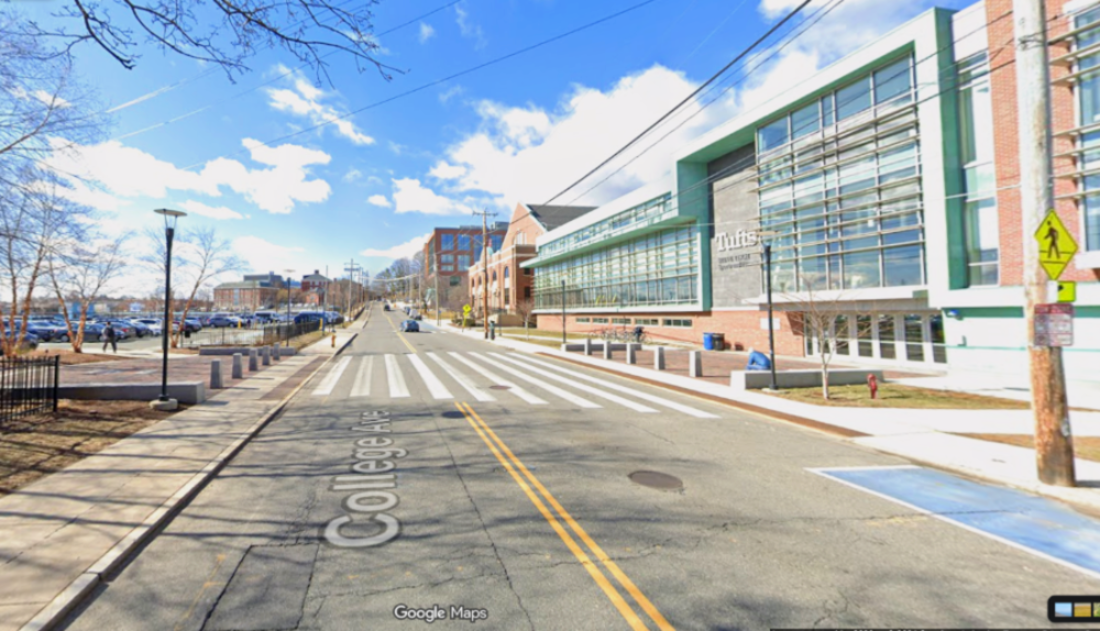
Farther along, on College Avenue, I walk past the recent grandeur of Tufts in the form of the Steve Tisch Athletic Center and the Joyce Cummings Building. Both are unmissable and give the impression that Tufts is doing very well indeed out of its accomplished alumni.
Back in my youth, we’d sometimes arrange a pick-up game on the Tufts diamond across the street, a bunch of ragtag local kids marveling at the splendor of a decently-maintained, full-size baseball field. Far from welcoming any wayward young hardball enthusiasts these days, the field today is a well-fortified, state-of-the-art facility that allows “for practice and competition even in inclement weather. It will also make Jumbo Baseball more attractive to the highest-caliber student-athletes.”
And thus, one presumes, to the highest-caliber alumni donors.
At the crest of College Avenue, next to the Cummings Building, there’s the newest MBTA terminus, part of the $2.3 billion extension of the Green Line, taking in four new Somerville stops on the way to a refurbished and relocated Lechmere Station.
As I remember it, the Lechmere stop was once nothing more than an open-sided shed when I traveled into Boston State College on Huntington Avenue before it merged with UMass-Boston and my academic pursuits were transferred to Dorchester.
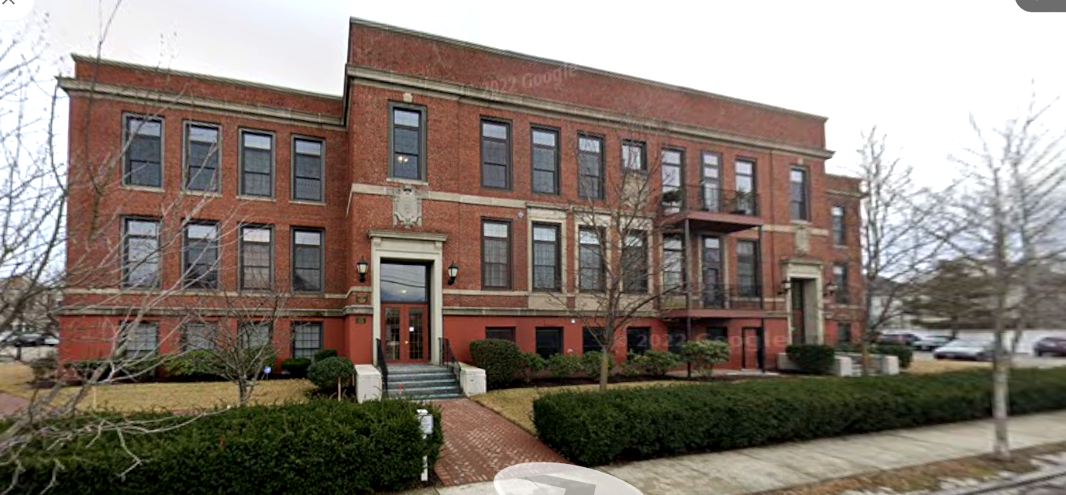
After a few moments of silent reflection on this changing landscape, I slip down Boston Avenue for a short distance and turn left onto Harvard Street. Five minutes later, I’m standing in front of another former school of mine, Lincoln Junior High, where during lunch and later in the yard I’d often witness examples of coercive behavior – or bullying in the vernacular – and so learned to keep my head down. (As did some of the teachers.)
It might be a coincidence, but it’s helpful to remember that South Medford – and nearby Winter Hill – was Goodfellas territory in the 1970s.
Erected in 1922, the Lincoln has been a condo complex for some time now. A definite pattern has emerged where my old schools are concerned, and I have no doubt that city officials will soon be putting Medford High on the market for commercial development rather than a proposed rebuild.
From a personal history standpoint, however, the best is yet to come.
Exiting onto Main Street, I turn right and walk past LaCascia’s Bakery toward a fork in the road across from the Tufts Park Pool. Thanks to the curious efforts of Medford’s traffic management department, the fork is now more of a bent spoon, so I continue straight on, picking up what has become, improbably, Medford Street.
Two blocks later, I see the sign for Clayton Avenue and turn right for a look at the two-family house bearing the number 10. This is where my Italian grandparents resided from 1946 – when my father graduated from the High School of Commerce in Boston and his family departed the West End – until the early 1970s, when my grandparents passed away within a year of each other and my father arranged to sell the house.
For many years, we had our Sunday afternoon dinner here – perfectly-prepared pasta with homemade sauce and meatballs, sprinkled with freshly grated parmesan, and later the piquant aroma of percolating coffee – before heading over to my mother’s Irish parents in Cambridge to wrap up the day.
The house looks exactly as I remember it, which perhaps isn’t saying much for any of the subsequent owners. A beat-up motorbike and an older model Toyota Corolla are parked out front.
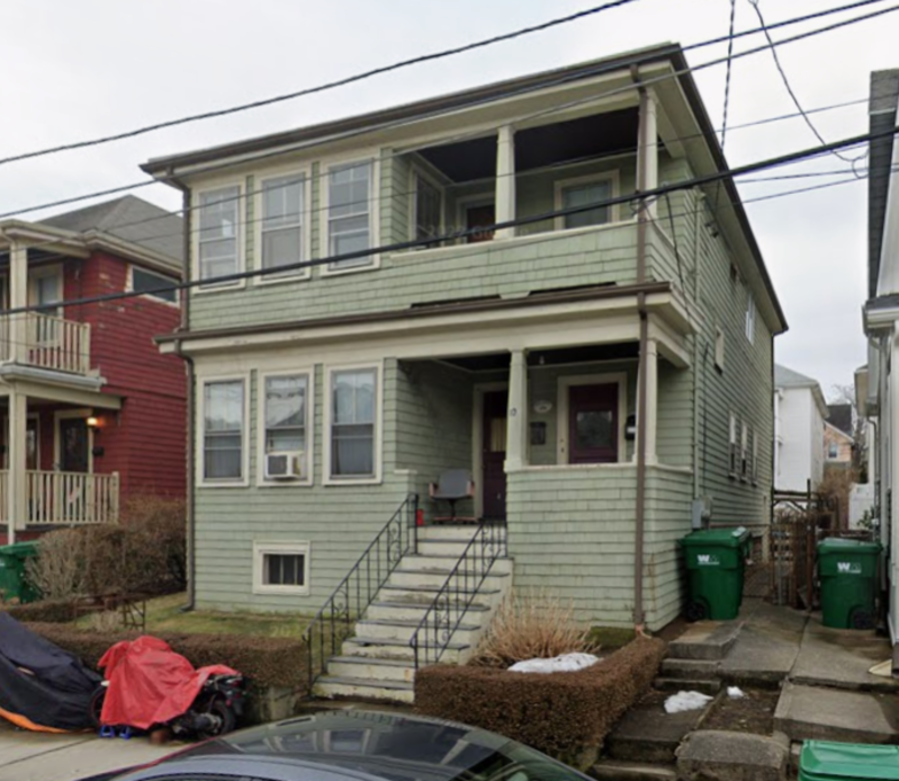
Looking down the side, I can spot a trellis framework in the back. My grandfather used to grow his own tomatoes, peppers, and grapes, nurturing them in the cellar over the winter and then transplanting them outside once the risk of frost had passed.
Eventually, he converted the grapes into wine. When he became our Sunday guest for a short time after my grandmother died, he’d bring a small pitcherful, carried in a brown paper bag, to enjoy with his dinner.
Departing Clayton Avenue, I stroll up the hill to Magoun Square – I’m now officially in Somerville – and turn down Broadway toward Trum Field, home to a couple of nicely groomed baseball diamonds.
Farther along, I enter Ball Square, home to one of the new Green Line stops, and I take a wistful look down Willow Avenue, all the while resisting an urge to visit Lyndell’s Bakery on the corner.
Three or four times a week, for seven years, I walked the length of Willow on my way home from the Star Market in Porter Square, where I worked in the produce department while attending UMass-Boston. Thanks to the weird and wonderful cross-section of people employed there, the Porter Square Star also contributed in a significant way to my education. (Indeed, the many after-work confabs held in the nearby Stephen James House – since razed and converted to housing – were particularly enlightening.)
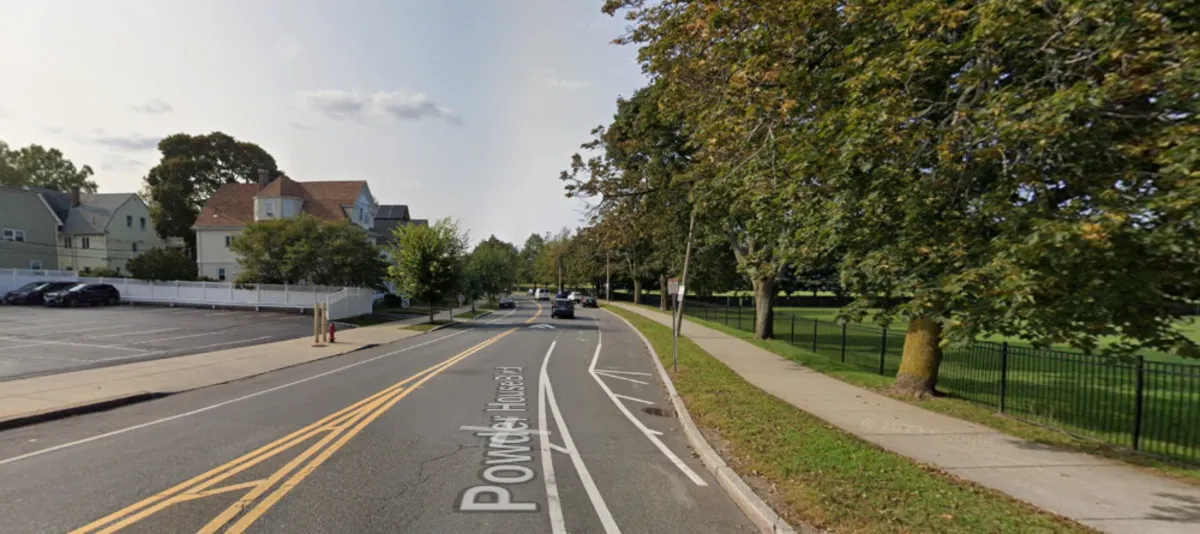
By this time, I’m ready to cover some ground that’s more or less memory-free. This takes me first down the broad sidewalks of Powder House Boulevard, along the lower outskirts of the Tufts campus. Here one is likely to observe the exotic cut of the modern college undergrad, all inked up and hair aglow with some candy-color dye job.
I then meet up with Route 16 for a short stretch, passing Dilboy Field, and hop over to Route 60 for a pleasant ramble beside the Mystic River in the direction of West Medford. At this point, I can extend my loop or bring it on home.
I decide that an exploratory excursion into Arlington Center for a poke around The Book Rack, followed by a peek at the Mystic Lakes, are best left for another day. So I cut down Harvard Avenue (not to be confused with Harvard Street, as some have done), pick up Boston Avenue (again), and head toward the Hillside and home.
As a famous American author once declared: You can’t go home again.
Perhaps.
But as my hometown walking tours have shown me, you can retrace some steps that will get you pretty darn close.

Medford native Steve Coronella has lived in Ireland since 1992. He is the author of “Designing Dev,” a comic novel about an Irish-American lad from Boston who's recruited to run for the Irish presidency. His latest publication is the column collection “Entering Medford – And Other Destinations.”