Table of Contents
By Crystal Yormick | Correspondent
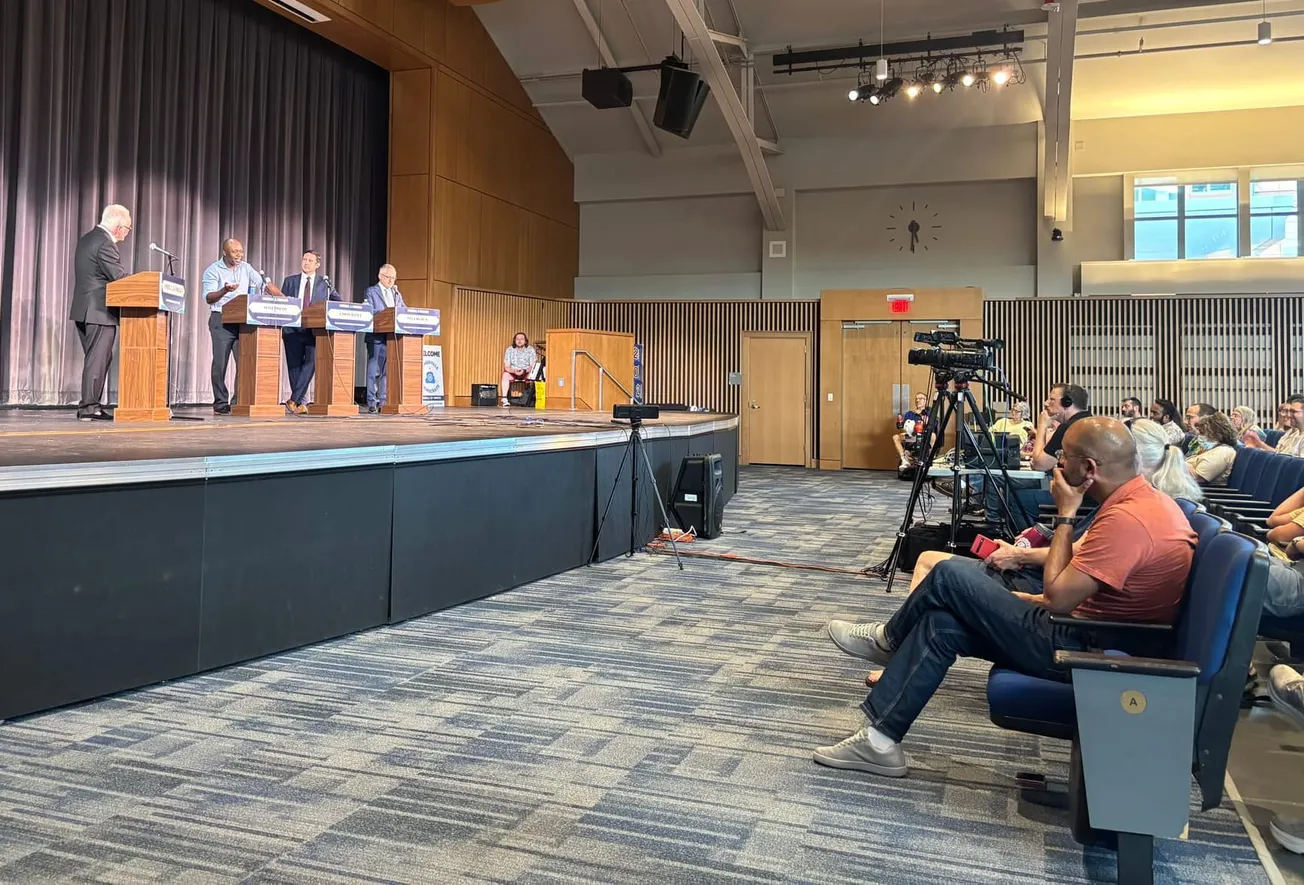
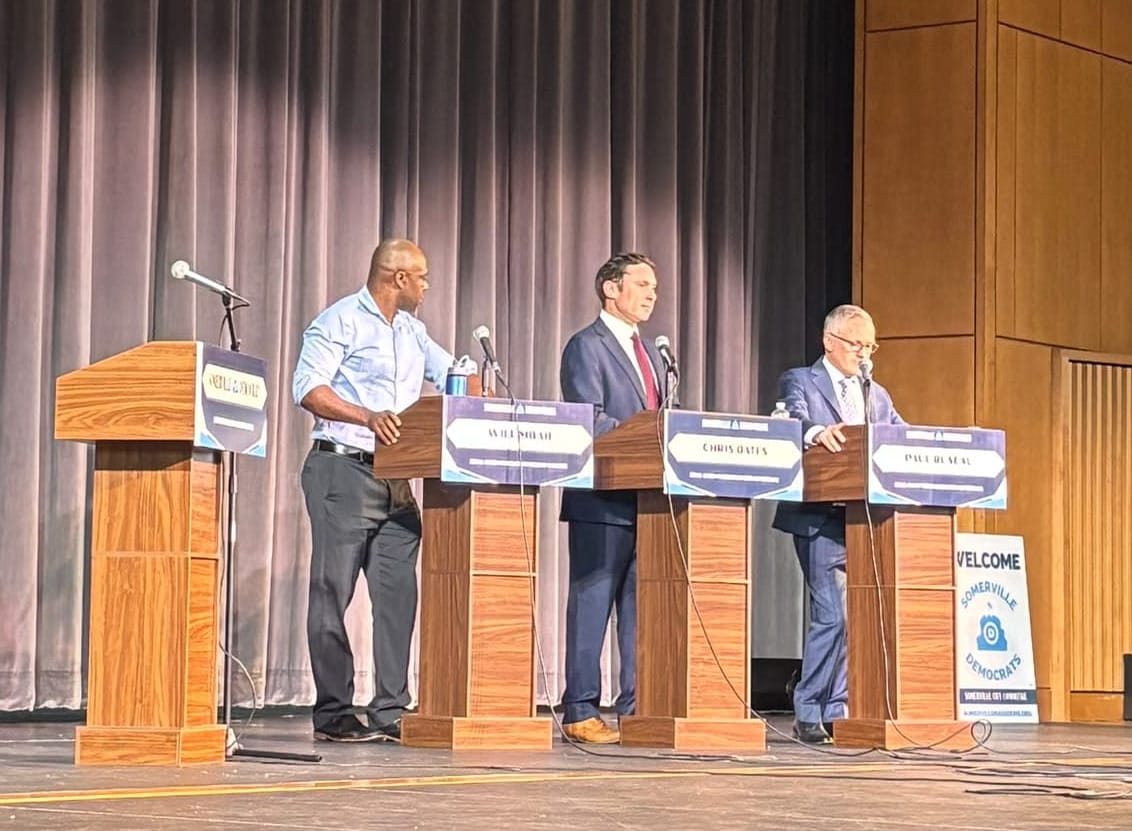
With less than a month to go before the primary, candidates for the 34th Middlesex House district seat discussed their legislative styles, approach to getting bills through the legislature, and tactics for dealing with issues Saturday, Aug. 1, at a forum at Somerville High School.
Topics included rent control, education funding, and healthcare, and candidates had a minute and 15 seconds to answer each question.
Rep. Christine Barber, who currently holds the seat, is running for the 2nd Middlesex District Senate seat, so this year’s race is wide open. The three candidates in the running, William Mbah, Chris Oates and Paul Ruseau, all bring similar values to state government, but hold different top priorities and ways of achieving their goals.
About 70 voters gathered for the panel, the first of three held that afternoon. The candidates for the 2nd Middlesex Senate District and 27th Middlesex House District seats also held debates at the event.
There is not a Republican, third-party or un-enrolled candidate that has qualified for the November general election, so whoever wins the primary Sept. 1 will most likely be the next state representative for a district that consists of parts of Medford and Somerville.
Meet the candidates

Mbah, a four-term Somerville city councilor, is running a campaign rooted in his past experiences on the City Council and track record, which he said differentiates him from the other candidates.
He is focusing on a series of issues, including affordability, immigrant rights and equitable public safety, climate, infrastructure, arts and culture, education, worker protections and government transparency and responsiveness, according to his campaign website. His approach to public service has been shaped by his own experiences in the community as a resident and parent.
“This district deserves more than good intentions,” Mbah said. “It deserves proven leadership... Every resident deserves a representative who listens, who shows up and who gets things done. I’m that person.”
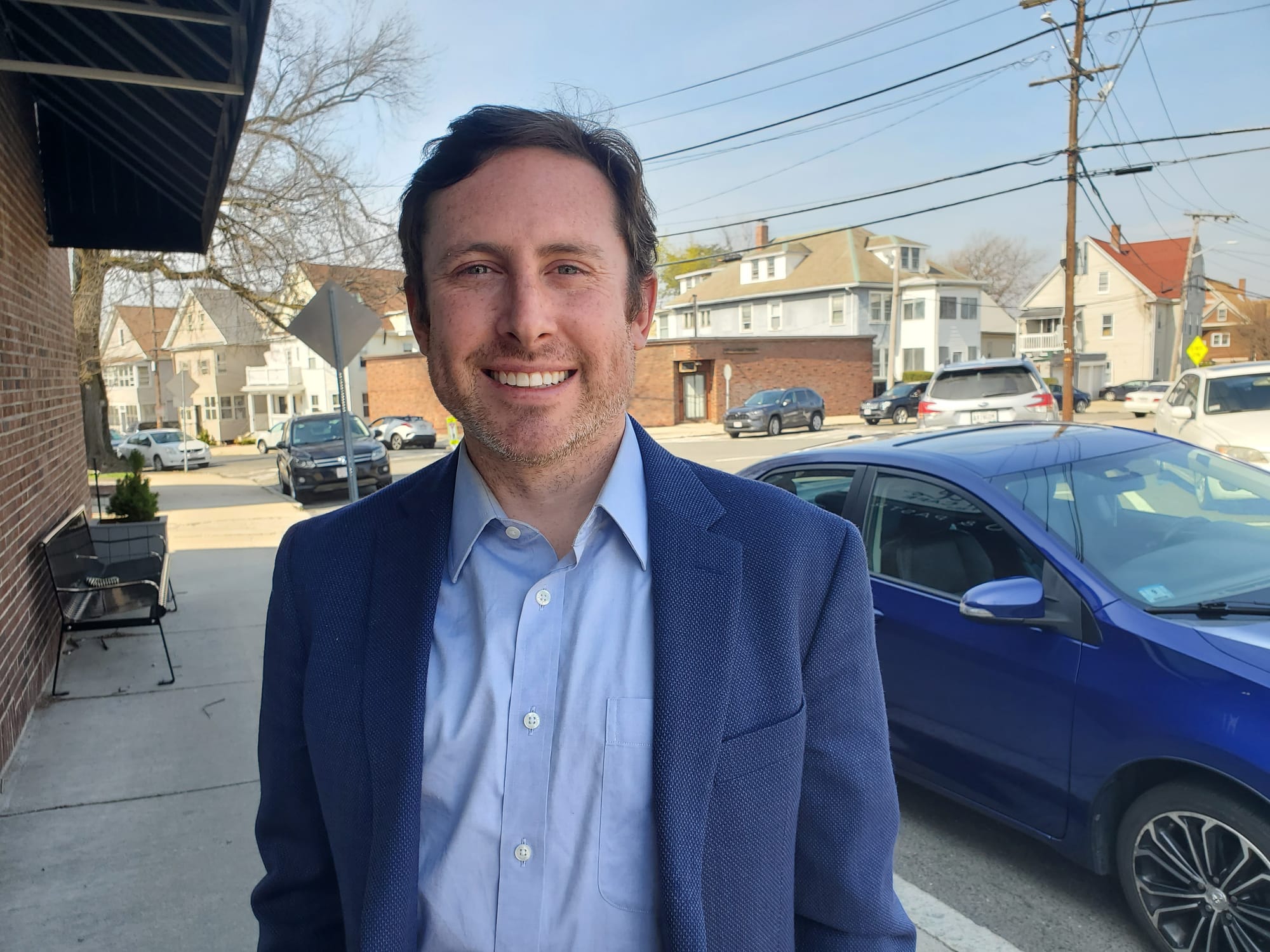
Oates, vice chair of the Ward 4 Somerville Democratic Committee, said he thought his career would be in foreign policy, which for a while, it was. However, he realized that the work he was doing and his own personal experiences, from childcare to traffic to mental health, were decisions made at the state level.
His campaign is focusing on bringing down housing costs, increased use of the commuter rail, cleaner and cheaper energy, protecting immigrant communities, supporting local journalism, banning gambling ads from live sports, creating sensible tech regulations, and matching funds for elections.
“Your representative should listen to you, work with advocates and activists and experts to try to diagnose the problem and then actually solve them,” Oates said.

The top priority for Ruseau, who has served on the Medford School Committee for the past nine years and works at the Dana-Farber Cancer Institute as a software engineer, is implementing Medicare for all across the state. His background growing up facing food insecurity and homelessness gives him first-hand experience of someone who knows what happens when the government fails, he said.
His campaign has five focuses: education and childcare, healthcare, housing stability, protecting immigrant communities, and fixing local aid, according to his campaign website.
“[Medford Public Schools] is an unrecognizable school system after five terms in office,” Ruseau said. “I plan to take that same approach to the State House, where I’m going to subvert my other 750 priorities to the ones that are most important now, like Medicare for all.”
Questions and answers on issues
QUESTION: The three of you, all progressive Democrats, are seeking the same office, and you agree on many of the problems facing this district. Many voters are looking not just who agrees with them, but who is most likely to successfully legislate on them. Could you each speak to what kind of legislative style you will take and how you intend to be the most effective legislator for this district?
Mbah: What differentiates him from the other candidates, he said, is his proven track record that shows he can get the job done and knows how the system works. He said he brings a holistic approach to government as a representative because he has experienced most of the issues of the commonwealth personally.
Oates: Solutions to issues need to appeal to people on a state-wide level, not just on a municipal level, in order to pass in the State House, he said. The best way to align interests between communities is to work with advocacy groups across the state to find out what the issues are and what a good solution would be, he said.
Ruseau: He said he plans to take a similar approach to what he took with Medford Public Schools where he focuses mainly on the issues that are most important now, like Medicare for all. Values are important to talk about because policy can be difficult for people to understand, but values are not, he said.
QUESTION: One word, what is your legislative style?
Ruseau: Coalitions
Chris: Coalitions
Mbah: Coalitions
QUESTION: Which one legislative committee would you most like to serve on, why, and how do you expect to get that assignment?
Ruseau: Healthcare financing, he said, to discuss implementing Medicare for all and steer the conversation away from the “annual freakout” the state has each year when it has to figure out how to pay for healthcare costs.
Mbah: Housing and environment, he said. He would like to be on other committees that address issues besides housing, such as transportation, healthcare, immigration and climate resilience.
Oates: Joint Committee on Children, Families and Persons with Disabilities because it is the one where he could make a big impact, especially as a first-term representative, he said. If he doesn’t get that, he would like the economic development committee to try to build the economy.
QUESTION: Councilor Mbah, during your time on Somerville City Council, you voted to send Beacon Hill many home rule petitions, including on rent control, a real estate transfer fee, tenant opportunity to purchase, municipal voting rights for 16 and 17 year olds, among others. All of these proposals have languished in the legislature. If you are elected, what specific tactics would you use to get Somerville and Medford home rule petitions through the State House?
Mbah: To push legislation forward, the education and outreach methodology has to change, he said. We have enabling legislation to offer communities the option to demonstrate what works for their communities to push this legislation forward and bring change that is specific to each community, he said.
QUESTION: Chris, if there’s a difference there between your style and Councilor Mbah’s, kind of highlight that.
Oates: Need to build a reputation and build trust within the State House, he said, so that leadership knows the representative has thought about the effects of a petition on the whole state, not just the individual community.
QUESTION: Paul, same style? Different style?
Ruseau: Ballot questions and local home-rule petitions are not very different because they both indicate, through trying to change the law, that the law is the problem and “we want an exception,” he said. If he were on the Rules Committee, one rule he would implement is restricting the number of bills a legislator can file.
QUESTION: Somerville and Medford have some of the highest costs of living expenses in the nation. Councilor Mbah, you support allowing municipalities to adopt rent stabilization. Mr. Oates, you have emphasized removing zoning and permitting barriers to private housing construction. Mr. Ruseau, you’ve called for a substantial expansion of publicly owned mixed-income social housing. Which of those approaches would reduce housing costs most quickly, and what evidence can you provide that will support your answer?
Mbah: There needs to be a “multi-pronged approach” to housing, not a “silver bullet,” he said. Rent control is the only way forward, but in order to do this the “Yes, in My Back Yard” bill needs to be passed to remove obstacles and encourage the “Yes, in God’s Back Yard” bill.
Oates: Emphasize production and bring down the cost of construction with permitting reform, he said. The fastest way to drop rents is a large increase in supply, and by doing so, the state could generate the revenue needed to cover affordable, public and social housing. This way the subsidies for housing would go further.
Ruseau: Rent stabilization would bring costs down the quickest, he said. However, the state also needs to de-commodify housing as an asset to combat the “inheritocracy” we live in. People talk a lot about building, but the market has been around for a while and the problem is not solved. If building housing was the solution, it would have already been solved.
QUESTION: Somerville schools have repeatedly been under financial strain, and the city has dedicated substantial funding to try to improve educational outcomes. Mr. Ruseau, you have a solution: rewriting the Chapter 70 Education Aid Formula and removing its inflation cap. How much additional funding would your proposal require? Where would that money come from, and how would you persuade legislators representing communities that might receive a smaller share?
Ruseau: He said he doesn’t agree with having a floor in Chapter 70 formula “on principle” because communities that don’t necessarily need aid get it anyway, and he thinks that it should be removed. In Somerville and Medford, schools get less money from the state every year, which results in unpaved roads, not hiring enough teachers, or not giving appropriate raises to make up for it.
QUESTION: Councilor Mbah and Chris Oates, do you agree with that approach? And if you don’t, what’s the difference?
Mbah: He said he supports what Ruseau is saying that the state can do more to change the formula to make it more equitable across communities.
Oates: If the state does reopen the funding formula, it would most likely look into what the next 15 to 25 years will look like because of decreased birth rates and hence decreased student populations, he said. The ensuing debate will be steered by representatives in areas with falling student populations because spending is mainly per student.
QUESTION: Mr. Oates, you have never held elected office. What experience do you have that Councilor Mbah and Mr. Ruseau do not that voters should consider you?
Oates: He said he worked on the ranked choice voting campaign, a statewide ballot initiative, in 2018 through 2020, so he spoke with people across the commonwealth and built support for election reform without a specific local example to point to. This gave him the coalition-building experience needed to get laws across in the state legislature.
QUESTION: Will and Paul, you were once candidates who had never been elected yourselves. You got anything you want to offer to Chris on first-time candidates?
Ruseau: Addressing the system itself is the only way to make any changes, he said. Thinking about passing a bill and cosigning it does not mean it will change anything because of how the system is set up.
Mbah: He commended Mr. Oates for his courage and said he is happy because this is where we see the contrast between candidates and what each one stands for.
QUESTION: Councilor Mbah, you have stated that if elected, you will step down as a Somerville city councilor. Mr. Ruseau, you have said that you would continue working at Dana Farber while serving in the Legislature. To each of you, would you intend to serve as a full-time representative?
Mbah: He said he would step down to fully focus on both districts and serve them with the skills residents entrust him with to serve as a state representative to respect the cities of Medford and Somerville
Ruseau: He has already been balancing his job at the Dana-Farber Cancer Institute with his School Committee role, he said, and when he takes on a responsibility he organizes his life around it. The question should not be if he has another job, but on whether he shows up, remains accessible and delivers, he said.
Oates: This would be his full-time job starting Sept. 3, he said, after taking one day off after election day. He plans to give his company up to someone else in the meantime to put all his effort into being a representative, apart from his time spent as a caregiver for his child.
Ruseau: He responded to Oates by saying that for many people, including himself, $82,000 — which is the amount representatives are paid — is not enough to live on for a year.
QUESTION: Mr. Ruseau, you support establishing a state single-payer healthcare system. Mr. Oates has said he doubts that single-payer healthcare is workable at the state level, more so with federal cuts making state budgets even tighter. Mr. Ruseau, how would you finance single-payer, especially without federal cooperation. And Mr. Oates, if state single-payer is unworkable, please explain your alternative for improving healthcare costs and access in Massachusetts.
Ruseau: On top of the 4% millionaire’s tax that already exists, he said, there should be an additional 1% added to that for every additional million, and it should cap at 12%. This would generate $8.7 billion a year, he said.
Oates: He said he thinks this is unworkable because the healthcare system is split between the state and federal government. If healthcare costs go up, the federal government can run deficits, but Massachusetts cannot. Because of this, the money to cover healthcare would have to come out of somewhere else, like teacher’s salaries or the MBTA, he said.
QUESTION: Councilor Mbah, which one is right?
Mbah: Mr. Ruseau, he said. It is a “no-brainer” to push for policies, such as the millionaire tax, that direct money to healthcare.
QUESTION: This next question is about the commonwealth Stabilization Fund, also known as the Rainy Day Fund. Hopefully, all of us have a little rainy day fund socked away as individuals, but some don’t. Mr. Ruseau, you’ve advocated using part of that fund to prevent cuts resulting from reductions in federal assistance. Mr. Oates, you have expressed some reluctance to use the commonwealth’s rainy day fund outside a recession. So Mr. Ruseau, should we dig into the rainy day fund to protect Massachusetts residents from the effects of the Trump administration’s budget cuts.
Ruseau: Yes, he said. If Trump never goes away, and we don’t have another election, this is not one of our largest problems. The system can handle another three years of $600 million of coverage from the rainy day fund. The entire fund shouldn’t be used to close these gaps, but he would consider it “raining” right now, he said.
QUESTION: Mr. Oates, is that a responsible way to use the rainy day fund?
Oates: It can be, he said, but it comes down to the situation the state is in. He said he cannot say for sure what he would do because he doesn’t know what the economy will look like in 14 months. If there is not a recession by the time funding decisions need to be made, then he would use the rainy day fund to prevent these cuts. However, if there is a recession, then this money would need to be used to prevent Massachusetts from running a deficit.
QUESTION: Councilor Mbah, you’ve had to make these kinds of decisions on Somerville City Council. You’ve utilized stabilization funds in the past. Do you agree with the approach here?
Mbah: 100% agree with Mr. Ruseau. The rainy-day money needs to be used to stabilize the community.