

Medford High School building plans underway, public receives first look at behind-the-scenes preliminary work
The Medford Comprehensive School Building Committee held its first community meeting, giving the public its first behind-the-scenes look at the new high school project.

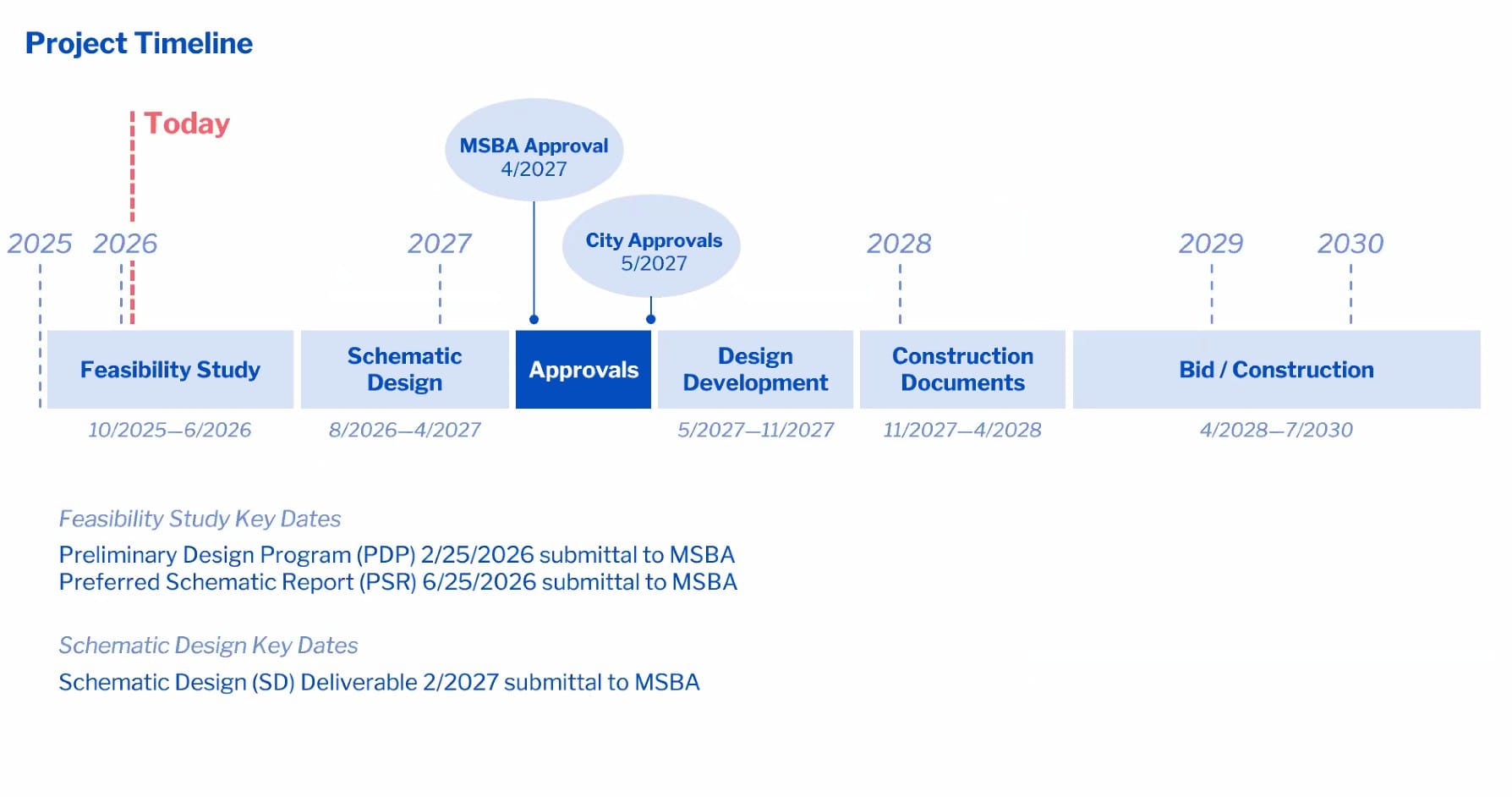
The ball is rolling. But there’s still a lot to be done by June 25 when Medford submits plans to the state for a new high school.
That was the message on Jan. 7 when school officials, architects and planners held their first community meeting to explain the history, current process and future expectations behind a new building.
Medford School Committee Vice Chair and Medford Comprehensive School Building Committee (MCSBC) Chair Jenny Graham kicked off the meeting with an introduction to the teams at LeftField Project Management and SMMA, the architects and designers of the new school, as well as the members of the building committee.
“The School Committee under its authority, appointed a 25-member committee in April of 2024,” she said. “What we set out to do was create a committee that is comprised of the right mix of people from across a lot of different specialties, both within our schools, within our city government, across some elected officials, and of community members who have particular skills and talents that we thought would make a well-rounded team.
“And as we did that, we had 110 applications for this 25-member committee, on top of all of the appointed people who are required by the MSBA, like the mayor and the superintendent and others,” she said. “We thank them for their input and their support as well. This team has been working really hard to move through the paperwork phase of this process.”
History of MHS, renovation plans
Medford High School was originally built between 1894 and 1896 at 22-24 Forest St., where Chevalier Theatre and the post office now stand. A rear wing, which included a gymnasium, was added in 1914.
Between 1929 and 1939, city officials added more wings to the building. Those would turn out to be the only buildings in use following a Nov. 1, 1965 fire that started in the school’s boiler room.
The Forest Street fire burned for 12 hours, destroyed 33 classrooms and cost the city almost $2 million in damages. City officials decided it was time for a new building and eventually landed on the school’s current location at 489 Winthrop St.
Construction of the building began in 1970. Instruction was continued at the usable wings of the former high school on Forest Street, with students attending in half-day sessions.
In 1971, the new building was officially opened.
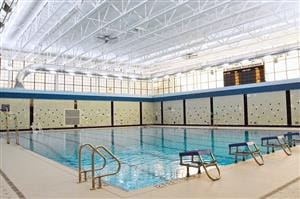
In the early 2000s, MHS underwent a renovation after the city built four new elementary schools and two middle schools. More work was done at the high school between 2013-14 to upgrade science labs and re-open the pool.
Over the next several years, school and city officials worked to bring a plan together for a new high school. In 2022, Medford was selected to be part of the Massachusetts School Building Authority’s (MSBA) Core Program.
That bid, however, was not successful.
“Those pre-2022 bids were not successful and I think as we moved into 2023, we took a different approach to that application and we really dug deep into a handful of things,” Graham said. “One was the educational limitations that the current building provides, as well as some of the ongoing maintenance issues that were increasing in scope and scale as the building ages. I’m not a building expert myself, but what I’m told is that this is not at all unusual for buildings built in the 1970s to be. At this point of, [we] were really thinking through the future of the building.”
Graham added 2022 was a difficult time with post-COVID-19 construction costs “through the roof” and inflation being “very, very high.”
“And the MSBA, because of its budget constraints, was only able to let in a fraction, maybe say, 60% or 70% of the projects, the core projects like ours, that they normally would in a year,” she said. “That was also the year where they halted their accelerated repair program that did things like roof replacements, doors, and windows. So, that budget year was rough sort of all around.”
Graham said the district took all that feedback and re-submitted its application in 2023 and that December was informed it was once again invited into the program.
“And what that means is we will partner with the MSBA through a process that they have designed because it works to build something different here than what we see today,” she said, adding there are two hallmarks behind the MSBA process. “One is that they really push districts and communities to be thoughtful about what they’re trying to accomplish in the building, and what kind of a building they require in order to accomplish those goals before we get into the conversation of where does the building go, and is it three stories or four stories? So they really encourage a very methodical approach that goes from one step to the next.”
And of course, there’s that state money.
“The most exciting reason to be invited to the MSBA core program is that the state will share in the cost of the program with grant funding to Medford,” she said. “Our reimbursement rate, we’re not going to talk a lot about that, is over 50%.”
Where Medford is in the process
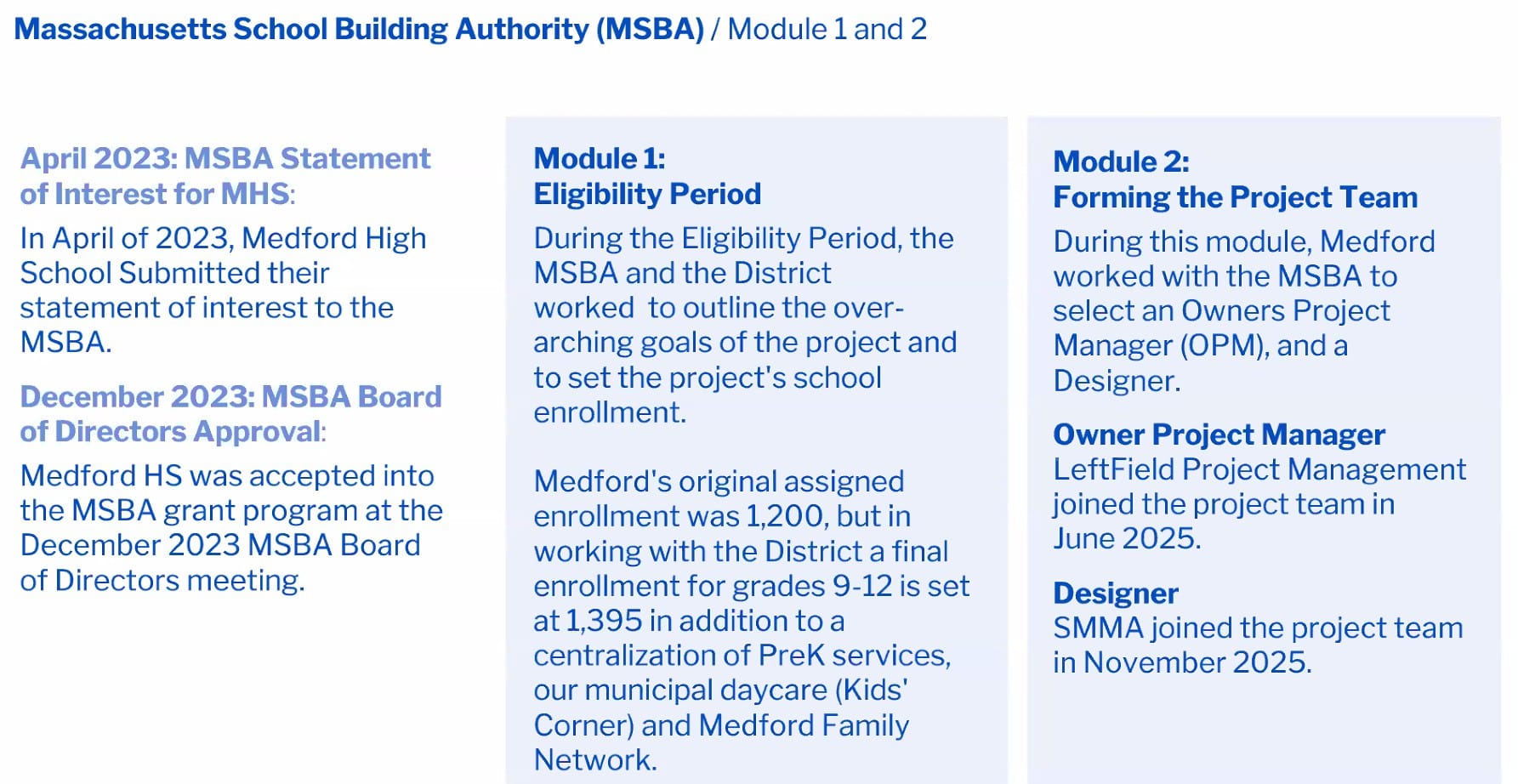
Medford has already moved through the MSBA’s first and second “modules,” where the state sees if the district meets its eligibility standards. During Module 1, the MSBA worked with the district on the “overarching goals of the project” and set the school enrollment.
Initially, the MSBA assigned Medford a 1,200 student enrollment. That number has since changed to 1,395 for grades 9-12 and also includes “the centralization of Pre-K services,” Kids’ Corner and the Medford Family Network.
Module 2 includes the hiring of an Owners Project Manager (OPM) and designer. LeftField Project Management was hired in June 2025 as OPM followed by SMMA in November 2025 as designer.
In October 2025, Medford was invited into what is referred to as the Feasibility Study stage, which runs through June. This phase includes the preliminary design program, which must be submitted to the MSBA by Feb. 25, as well as the preferred schematic report, the deadline of which is June 25.
What does it all mean?
“The majority of the information that is being submitted at this stage in the project is a lot of information gathering and fact-finding that we’re doing throughout the school, not just on the inside, but we’re also evaluating all of the conditions of the site,” said LeftField Project Manager Matt Gulino said of the Feasibility Study.”
He said that includes things like traffic patterns, the size of the property and the wetlands that surround the site.
“We’re really just trying to understand exactly what this site is and what this building looks like, in its current state,” he said. “We also touch on educational visioning to create an educational program, or an ed plan. The educational program is really the cornerstone of the project. It dictates the overall square footage of the building, and it really highlights the delivery of education in Medford, both now and how it wants to be delivered in the future.”
Gulino said the MSBA is very specific in what it wants to see in the documents submitted by Medford.
“It’s a very large document that has a lot of information, and really, at the end of the day, will kind of drive the overall size of the project,” he said. “The other thing that we’re working on right now is looking at alternative options. This is also a requirement of the MSBA. We need to study what it would it cost, and if it is actually feasible to do just a code upgrade of the building, a renovation of the building, an addition renovation of the building, or a new building. So as we start to gather all this information from the existing conditions and the educational program, we will start to create a bunch of different options of all of those different construction types and we’ll slowly start to kind of figure out which one fits best, both from an educational standpoint and in a cost standpoint.”
The educational plan
The schools have been busy gathering information for the educational portion of the Feasibility Study. Visioning sessions with students, educators, staff and the community have been taking place over the past several months.
Interim Superintendent of Schools Dr. Suzanne Galusi said the conversations have focused on the learning environment, not just on facilities or spaces. She said the collective charge is to make MHS a place where there’s a sense of belonging.
“We want our students and our staff to be in spaces where they feel represented and valued and seen,” she said.
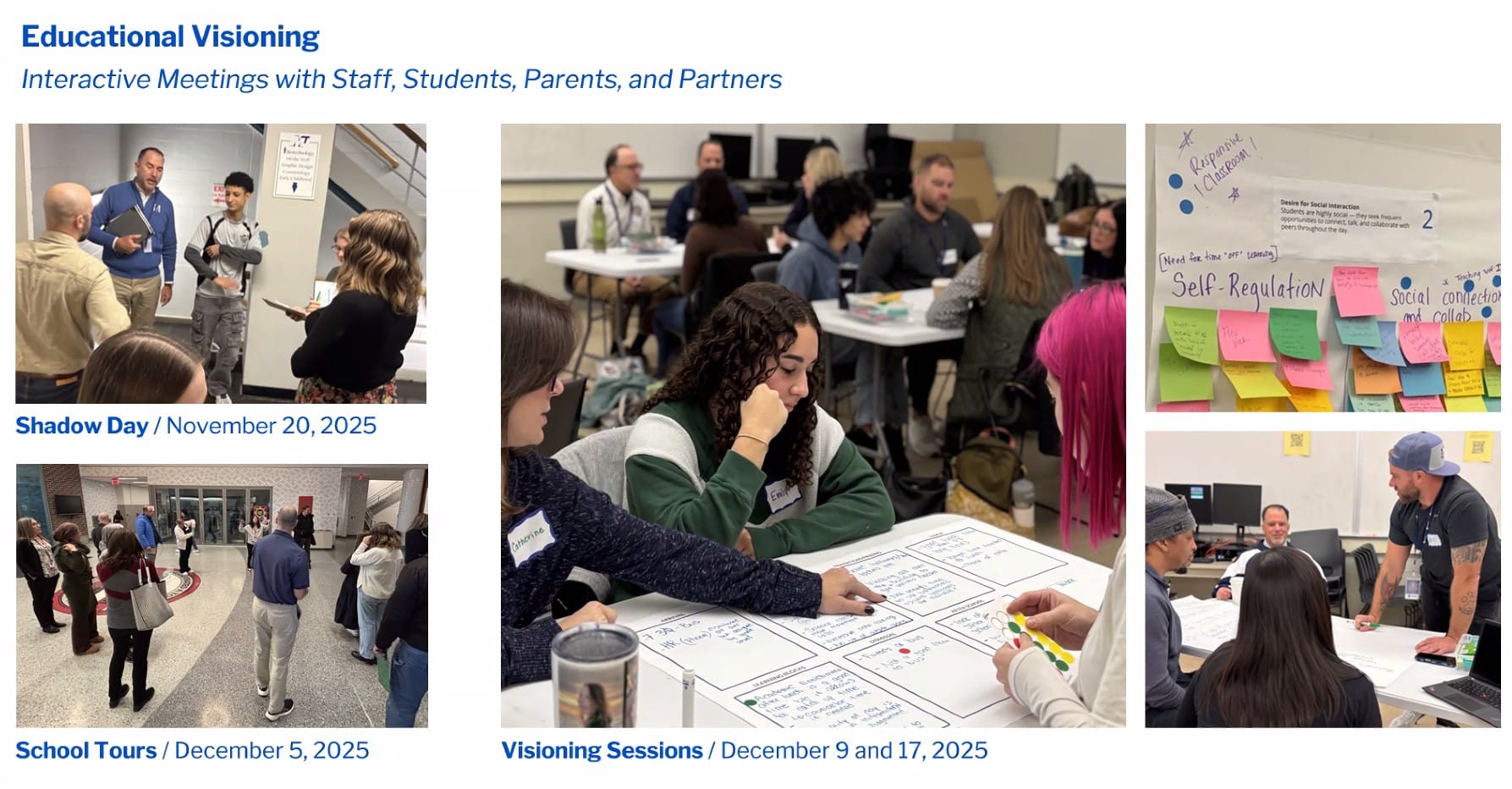
Galusi said SMMA designers have been examining the building, holding visioning sessions in December 2025, as well as taking tours, and holding a Shadow Day in November 2025 to see just how students interact with the facilities day-to-day.
Currently, MHS has a lot of maintenance issues, such as a leaky roof, systems problems with electrical, plumbing and HVAC. As an example, Galusi said it’s not unusual for people to complain about the different temperatures being felt throughout the building.
She added the visioning sessions have also been informative when it comes to seeing what students, staff and the community want their high school to be.
Those include, but aren’t limited to:
• A comprehensive, integrated high school that supports multiple pathways and identities within a unified school community
• Collaborative learning communities preferred over traditional corridors
• Career and Technical Education (CTE) integrated with academics expands access to real-world, hands-on learning
• Shared spaces add value when intentional, structured and instructionally driven
What that information adds up to is what gives designers an idea of what Medford could have in a new building. Galusi said designers have also heard that MHS could use an updated auditorium for not just student use, but that of the community.
And, she added, there’s a desire for more connection to the school’s outdoor space.
“There’s a desire to be more connected to the Fells,” Galusi said. “We want to offer more opportunity and enrichment not just for learning experiences, but for community experiences.”
As for the physical plant, Galusi said the MHS is large, difficult to navigate and often doesn’t fit in with the “instructional vision and how we want to be able to provide education for our students.”
“We’re not able to use it in the manner we need it to be in,” she said. “We see that impact on our learning.”
The property
Architect Matt Rice said both the building and site of where MHS sits are being looked at from every angle, not just the internal systems. He said thorough investigations also include a hazardous materials survey, geotechnical explorations, geoevironmental study, traffic counts, and environmental noise study, among others.
Rice said SMMA has already made several observations about the property:
• MHS is not visible from the street
• There’s only one point of entry, and exit, from Winthrop Street
• 54% of the site is paved with pockets of bedrock
• Few shade trees contributes to the heat island effect
• 80-foot vertical grade change across the site
• 0% of stormwater on site is treated for pollutants
• Majority of accessible parking spaces have slope issues and/or non-compliant signage
• Accessible routes have several issues of non-compliance
• Majority of public entrances have accessibility barriers
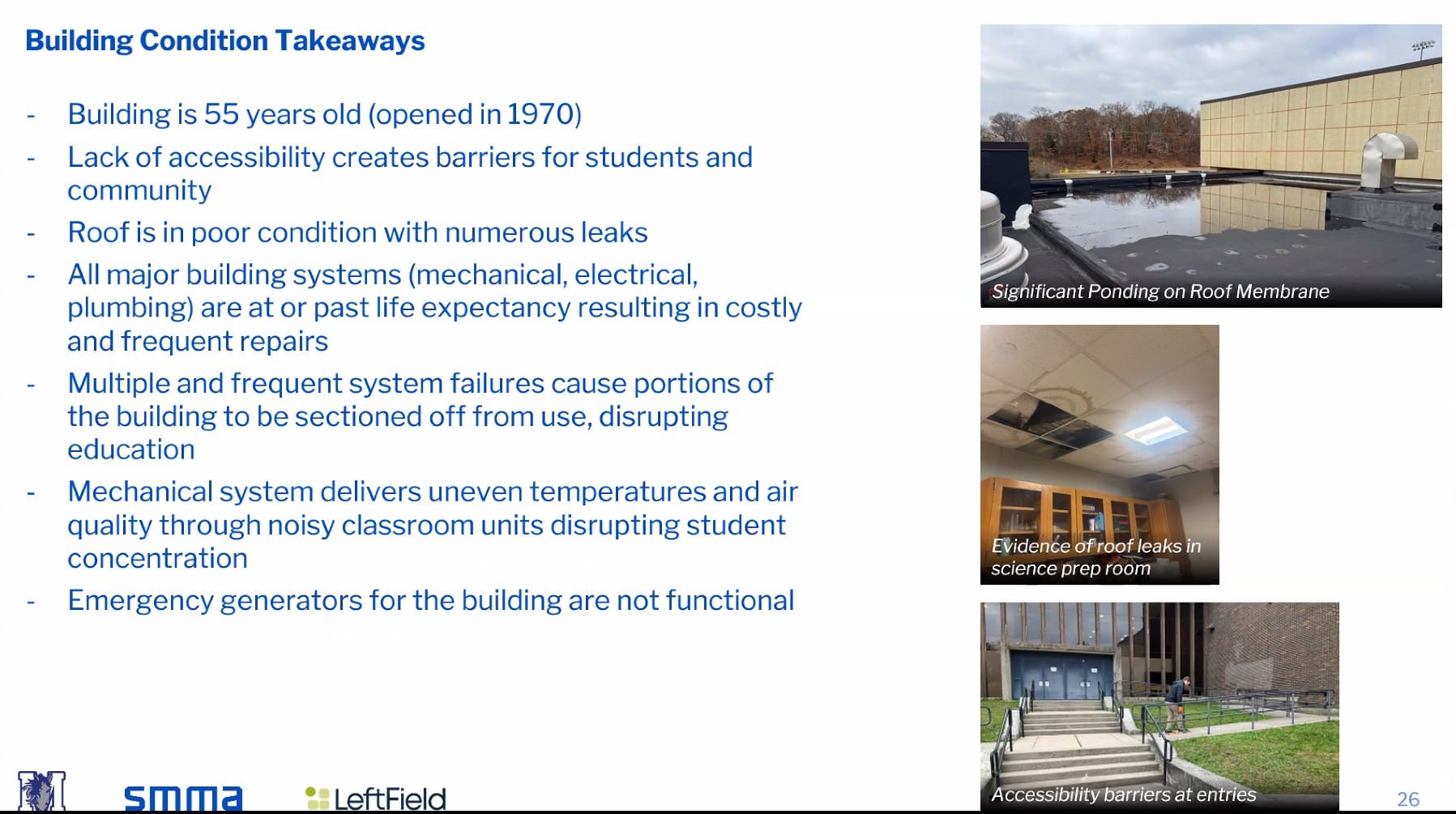
Rice added the majority of the school’s systems are original to the building and are at their end.
“They are all at their useful life expectancy, and so there’s valiant efforts that are being made on a daily basis to really combat things that are falling into disrepair, needing repair, and really causing challenges in terms of areas of the building that have to be sectioned off from use, which causes disruptions to the education going on,” he said.
Community engagement
There have been 49 programming meetings with everyone at Medford High School from every department and program head, whether academic or vocational.
Graham said the building committee has also formed advisory teams to “collect broad community input on key priorities and desired outcomes for the project.” She added the four teams are made up of educators, city departments, boards and commissions, expert community members and students.
The four teams are:
• Sustainability and MEP (mechanical, electrical and plumbing) systems: 16 members currently reviewing sustainable design features, healthy materials and site design and landscape features for environmentally friendly design.
• Educational Planning & Equity: 23 members currently reviewing educational planning perspectives, educational programming meetings and visioning sessions.
• Site, Safety & Security: 18 members currently reviewing site design for traffic, circulation, safety and security, parking, driveways and circulation, fields and offsite improvements and coordination with city departments.
• Exterior & Interior Design: 18 members currently exterior design concepts and reviewing the products and materials selected for interior finishes.
“Every time we put out a call to say we want people with particular expertise, I’m just completely blown away by how skilled and expert Medford really is,” Graham said. “So, we had no trouble appointing these folks with really particular and direct expertise about the things that we were here to talk about, so it’s always such a nice reminder of what Medford really is.”
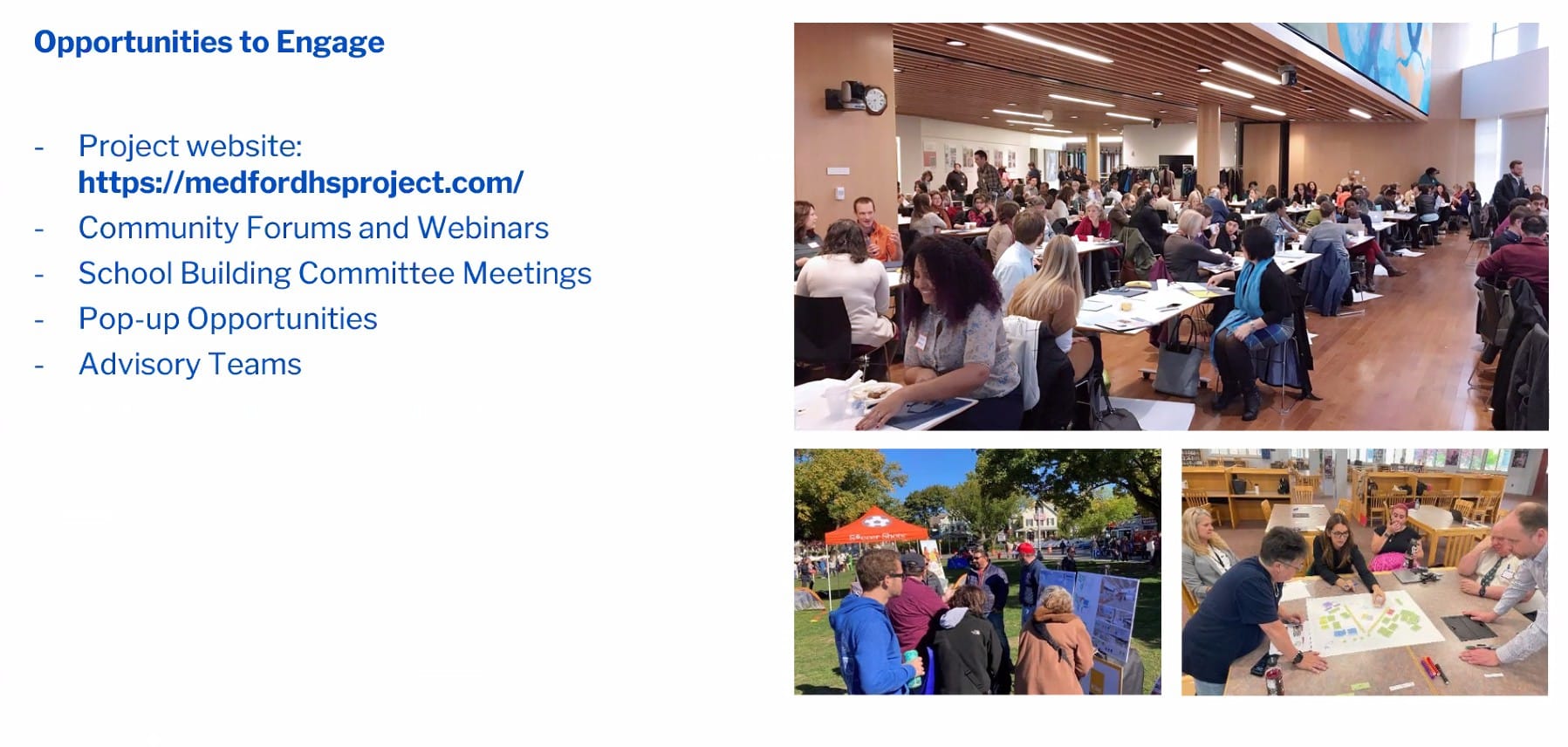
Graham added there are plenty of opportunities for the community to engage. For example, she said the online Jan. 7 meeting provided those who needed translation service to have that opportunity.
She said the community meeting, like all the building committee’s meetings, are also recorded and available for the public on the Medford Public Schools YouTube channel. She added the building committee meetings are about 90 minutes long.
Graham said there is also a project website, where information will be posted for the public to review as it becomes available.
And, she added, there will be other community meetings and webinars in the coming months and as long as the project continues.
“As we continue forward, you’ll start to see our extended team out and about in the community,” Graham said. “They’re really excited to hit the farmers market, which is being held at the Beer Hall right now in winter, so it is a nice warm spot, and then at different community events, different school events.”
Graham assured the public there would be plenty of opportunity to become engaged in the project at each step.

On Jan. 26, the School Committee will meet at 6 p.m. in City Hall to discuss a draft of the Educational Plan for review and input. On Feb. 2, the School Committee will once again meet in City Hall at 6 p.m. to review the updated Educational Plan and approve it for submission to the MSBA.
The building committee will continue to meet at the high school library at 6:30 p.m. on the follow dates: Jan. 14, Feb. 11, Feb. 23, March 5 and March 23. The meetings will include a first look at early building designs, rough cost estimates and finalizing the design submission.
The March 5 meeting will also be an opportunity for the community to give its input.
There will also be a QR code provided by the project partners for residents to provide their thoughts on the project.


